Biography
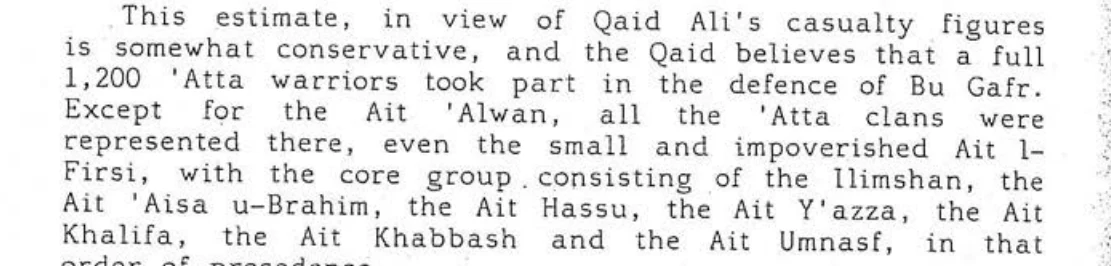
Assou Oubasslam is an Ilemchan: Spillmann calls him “sheikh of the Ilemchan” in 1930, and Hart specifies his lineage, the Aït Tzukinnit, and his segment, the Aït Bu Tghuratin (1984, p. 176). Bounfour writes that the “dissident” tribes of Bou Gafer were “led by Hssu u Ba Salm (Ilmshan tribe)”; Duclos mentions “El Haj Assou Baslam”, who negotiated the end of the fighting for the last defenders of the Saghro (“their submission”, in Duclos's words).
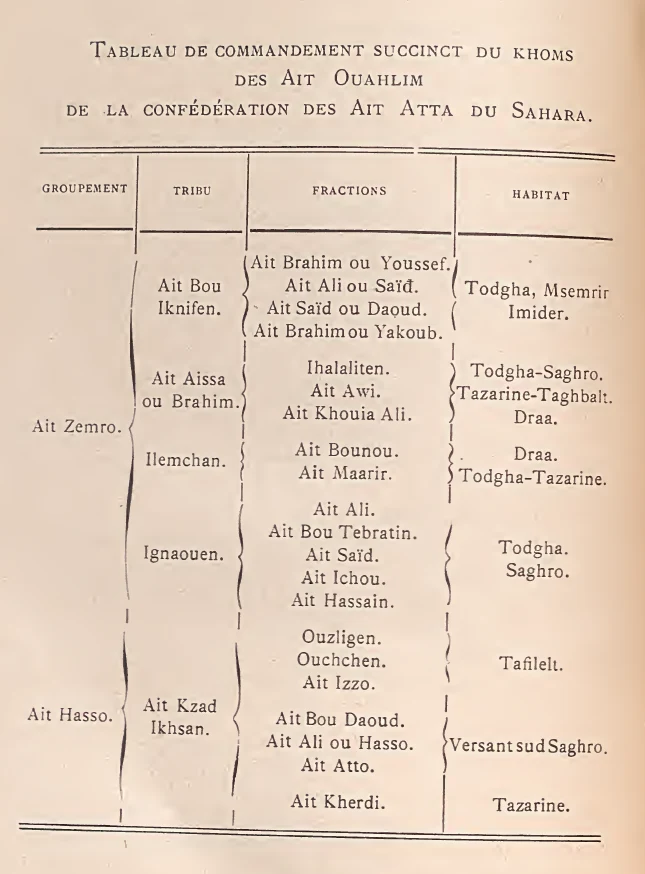
His attachment to the Aït Ouahlim goes through the classification into fifths, documented by three sources in the corpus. Lieutenant Beaurpère's table (1930) places the Ilemchan tribe, with the Aït Bou Iknifen, the Aït Aïssa ou Brahim and the Ignaouen, in the Aït Zemro grouping, one of the two groupings of the khoms of the Aït Ouahlim. Spillmann (1936) counts “Assou ou Baslam, of the Ilemchan” among the three notables of the Aït Ouahlim and reports that the Aït Atta divided this khoms into three “thirds”, one of them that of the Ilemchan and the Ignaouen. Hart finds the same two sub-fifths, Aït Zimru and Aït Hassu (1984, p. 11). These classifications by administrators and an ethnologist do not, however, confine his authority to the Aït Ouahlim: in 1933 he led, with his brother Basso, families from several khmas, and after 1933 he was caid of all the Aït Atta of the Saghro.
Hart (1984, pp. 176-178), who collected the testimony of his son, Qaid ʿAli u-l-Hajj, gives the biographical details: born around 1890 at Taghya n-Ilimshan, about twenty kilometres south-east of Tinghir; son of ʿAli u-Ba Slam, amghar n-tmazirt of his clan; himself amghar n-tmazirt of Taghya before 1919. A brother, Brahim, a son of the same name and a thirteen-year-old daughter, Fadma, died at Bou Gafer. The election as supreme chief in 1932 is reported only by encyclopedic syntheses.
On 25 March 1933, the last defenders of Bou Gafer led by Assou ceased fighting before Generals Huré, Giraud and Catroux. Saulay and Hart (after Huré) give two lists of conditions that do not match; according to Hart, Assou himself demanded that the Glawi's authority not extend to the Saghro and that customary law be respected.
After 1933, according to Hart (pp. 183-186), he was appointed shaikh, sat on the customary court of appeal at Iknioun, then in February 1939 became acting qaid, with the title of amghar n-ufilla of the Aït Atta of the Saghro, until his death “twenty-one years later”. In September 1961, Hart was received at Iknioun by his son, Qaid “'Ali u-l-Hajj 'Assu n-Ait Bâslâm”.
In 1981, asked by the Minister of the Interior whether he wished to resign, his son replied that the qaidship of the Aït Atta of the Saghro had been in his Aït Bu Tghuratin lineage of the Ilemchan “since the time of his grandfather Ba Slam w-'Ali”, and that Bou Gafer had only confirmed this command (Hart 1984, ch. 6).
Assisted translation, not validated
Uncertainties
- Date of birth: “about 1890” according to Hart (1984, p. 176), from family memory; no civil record consulted.
- Election as amghar n-ufilla in 1932: Wikipedia says so; Hart (1966, p. 94), after Spillmann, says the Aït Atta had a supreme chief “until 1926 or 1927”; Hart (1984, p. 186) states that after 1939 he was appointed by the French instead of being elected. See the comparison dossier.
- After 1933: French Wikipedia mentions exile then appointment as qaid in 1956; Hart (1984) describes a continuous career as shaikh then acting qaid from 1939, with no exile.
- A statement made during the negotiations is attributed to him online without a verifiable source: it is not reproduced.
- Date of death (16 August 1960): English Wikipedia, unreferenced. Hart (1984, p. 186) says he was qaid from February 1939 until his death “twenty-one years later”, i.e. around 1960: the year matches, the day remains unverified.
- Age: Spillmann gives him “about fifty” around 1930 (1936, orig. p. 84); Hart has him born around 1890, i.e. about forty in 1933.
- Hart (1984, p. 180) also places the Ilimshan in the Aït Wahlim fifth, but by taking up the French estimates of 1933, Spillmann's: this is not an independent confirmation.
- The attachment of the Ilemchan to the Aït Ouahlim fifth has been contested to the project. Rechecked on 9 November 2026 against the 80 documents of the local corpus: every source that classifies the Ilemchan (Beaurpère 1930, Spillmann 1931 and 1936, Hart 1984, Niaaskalen 2023) places them in this fifth, but these are classifications by administrators and ethnologists, partly dependent on one another. A source proposing another attachment would be added as a divergent position.
Sources — 10 sources cited · 9 independent documentary line(s)
- Wikipédia (français) — « Assou Oubasslam »Full text consulted · Encyclopedic synthesis
- Wikipedia (English) — « Assou Oubasslam »Full text consulted · Encyclopedic synthesis
- Hart, 1984 — p. 175-186Excerpts consulted · Academic researchBiography from his son's testimony; career after 1933.
- Beaurpère (lieutenant), 1931 — tableau du khoms des Aït Ouahlim (PDF p. 73)Excerpts consulted · Colonial military
- Spillmann et al., 2007 — trad. p. 33, 68-69, 113-115 (orig. p. 39, 83-84, 140-143)Excerpts consulted · Colonial military
- Hart, 1984 — chap. 6, « Conclusion », 1re page (PDF p. 259 ; texte lu sur l'image)Excerpts consulted · Academic research