Skip to content
SAGHRO

Archives & Photographs

Documentary evidence

Each piece of evidence is a specific page of a corpus document that was actually looked at. Quotations were checked on the page image; each document's rights decide what is shown.

The Sultan of Morocco receiving General Huré (Rabat, 1932) — Bibliothèque nationale de France (Gallica), via Wikimedia Commons, Domaine public

Method: search in the extracted text, reading of the page, check of the quotation on the image, capture rendered from the original PDF with its fingerprint, then publication of the image only if the rights allow it.

Document corpus →

Document
Contribution

36 pieces of evidence

  1. NuancesShort quotationSaulay, 1983, p. 55

    Saulay places the first movements from 11 February (patrols of the 7th and 17th goums, concentration of the Draa harka on 11-12, pp. 53-55) and the first clashes on 13 February: a Legion convoy is captured and an aircraft brought down.

    « Le 13 février, le groupement « B » attend vainement le signal de la région de Marrakech pour amorcer son mouvement. Le même jour, le convoi muletier de la Légion égaré sur une mauvaise piste, est enlevé par les Aït Atta. »

    These stages shed light on the diverging start dates (11, 12, 13 or 15 February): each date may refer to a different moment of the offensive.

    Document :
    La Koumia. Bulletin de liaison, n° 88 · Periodical issue
    Source :
    Saulay, 1983
    printed page
    printed page 55 · PDF page 59
    Status
    Quotation checked on the page image · 2026-11-07
    SHA-256 fingerprint of the private capture :
    b21601e7c5032879a125323be02465fcf4e9efb392f48abb4e8cd04308831620

    Reproduction of the page not authorised: reference and short quotation only. The capture stays in the project's private archive.

  2. CorrectsShort quotationSaulay, 1983, p. 57

    On 23 February, the “about 300 rifles” are the fezzas of Benedittini and Sergeant Lepape; the 21st goum supporting them is commanded by Lieutenant Aubert. The Aït Atta counter-attack comes “around 7.15”, after the partisans scatter.

    « Le capitaine de Bournazel donne ordre au lieutenant Benedittini d'attaquer à l'aube, avec sa fezza et celle du sergent Lepape, soit 300 fusils environ, soutenus par le 21e goum du lieutenant Aubert. »

    Internal inconsistency of the source, left as is: the order of the 23rd targets “piton 8”, but the narrative then places the final effort “almost at the foot of piton 6”.

    Document :
    La Koumia. Bulletin de liaison, n° 88 · Periodical issue
    Source :
    Saulay, 1983
    printed page
    printed page 57 · PDF page 61
    Status
    Quotation checked on the page image · 2026-11-07
    SHA-256 fingerprint of the private capture :
    f601bf456ce2c7deddb963cc623b8beceb2028c81299d9214a3448480567011f

    Reproduction of the page not authorised: reference and short quotation only. The capture stays in the project's private archive.
  3. ConfirmsShort quotationSaulay, 1983, p. 58

    On 18 February, 120 Aït Yazza tents obtain the aman.

    « Déjà, le 18 février, 120 tentes Aït Yazza avaient demandé et obtenu l'aman. »

    Account by a former goum officer, published in 1983 in the bulletin of a veterans' association of the Native Affairs service and based on French operation reports. The vocabulary (“submission”, “insurgents”) is the source's.

    Document :
    La Koumia. Bulletin de liaison, n° 88 · Periodical issue
    Source :
    Saulay, 1983
    printed page
    printed page 58 · PDF page 62
    Status
    Quotation checked on the page image · 2026-11-07
    SHA-256 fingerprint of the private capture :
    7681b6d8125afb1c7c1b4a232965758c8928ac6666e6918ea78ea95f362317b7

    Reproduction of the page not authorised: reference and short quotation only. The capture stays in the project's private archive.
  4. ConfirmsShort quotationSaulay, 1983, p. 58

    On 26 February, notables representing 400 fighters ask for a 24-hour truce; when it expires, a letter states “the will of all to resist to the end”.

    « des notables Aït Atta, représentant 400 guerriers, demandent au général Giraud une trève de vingt-quatre heures pour permettre à leurs jemaas de conférer entre elles au sujet de la soumission. »

    The site quoted “on behalf of 400 warriors”: the exact wording is “representing 400 warriors”.

    Document :
    La Koumia. Bulletin de liaison, n° 88 · Periodical issue
    Source :
    Saulay, 1983
    printed page
    printed page 58 · PDF page 62
    Status
    Quotation checked on the page image · 2026-11-07
    SHA-256 fingerprint of the private capture :
    7681b6d8125afb1c7c1b4a232965758c8928ac6666e6918ea78ea95f362317b7

    Reproduction of the page not authorised: reference and short quotation only. The capture stays in the project's private archive.
  5. ConfirmsShort quotationSaulay, 1983, p. 59

    On 28 February, Bournazel is wounded in the stomach, gets up, is wounded a second time, then carried back by two legionnaires. Saulay does not give the time of his wounds.

    « Le capitaine de Bournazel, qui vient d'être grièvement blessé au ventre, se relève avec une énergie surhumaine et se dirige vers ses goumiers qu'il sent fléchir. Blessé une seconde fois, il est abandonné par son maghzen de Branès dont il avait fait sa garde personnelle en souvenir des combats de 1925-1926 dans le Riff. »

    The heroic tone (“superhuman energy”) belongs to the officers' memory. The only times given for this phase are 7.30 (Captain Fourré reaches the saddle) and 7.45 (death of Faucheux and Brincklé).

    Excerpt of the printed page (capture) — Saulay, 1983, p. 59
    Excerpt of the printed page (capture) · Crop of the quoted passage only, published with the project owner's permission (statement of 8 November 2026).
    Document :
    La Koumia. Bulletin de liaison, n° 88 · Periodical issue
    Source :
    Saulay, 1983
    printed page
    printed page 59 · PDF page 63
    Status
    Quotation checked on the page image · 2026-11-07
    SHA-256 fingerprint of the private capture :
    e190275225c64b2c9481f9da657635a2175e07cf7b6121a9525a5d74b481bee2
  6. ConfirmsShort quotationSaulay, 1983, p. 59

    French and auxiliary toll of 28 February according to Saulay: 64 killed and 115 wounded; the fezzas of Alnif and Mecissi lose 17 killed and 22 wounded out of 130 engaged. For the Aït Atta, no figure: “if our losses were very heavy, theirs — as we would learn later — were much heavier”.

    « Les pertes sont très lourdes : 64 tués, dont les capitaines de Bournazel et Faucheux, les lieutenants Brincklé et Binet, 115 blessés, dont deux officiers. »

    Toll for one day, taken from French operation reports; the statement about Aït Atta losses is supported by no figure.

    Document :
    La Koumia. Bulletin de liaison, n° 88 · Periodical issue
    Source :
    Saulay, 1983
    printed page
    printed page 59 · PDF page 63
    Status
    Quotation checked on the page image · 2026-11-07
    SHA-256 fingerprint of the private capture :
    e190275225c64b2c9481f9da657635a2175e07cf7b6121a9525a5d74b481bee2

    Reproduction of the page not authorised: reference and short quotation only. The capture stays in the project's private archive.
  7. NuancesShort quotationSaulay, 1983, p. 59

    Saulay dates Huré's decision to suspend major attacks to 1 March; Gérardin places the halt order on 28 February at 12.20.

    « Le 1er mars, le général Huré décide de suspendre toute attaque importante et n'autorise que des opérations de détail pour rendre le blocus plus étroit. »

    The two dates may refer to two successive decisions (halt of the day's assault, then abandonment of attacks): SAGHRO does not decide.

    Document :
    La Koumia. Bulletin de liaison, n° 88 · Periodical issue
    Source :
    Saulay, 1983
    printed page
    printed page 59 · PDF page 63
    Status
    Quotation checked on the page image · 2026-11-07
    SHA-256 fingerprint of the private capture :
    e190275225c64b2c9481f9da657635a2175e07cf7b6121a9525a5d74b481bee2

    Reproduction of the page not authorised: reference and short quotation only. The capture stays in the project's private archive.
  8. ConfirmsShort quotationSaulay, 1983, p. 60

    After 28 February, only 1,800 partisans are kept; the blockade is entrusted to regular units backed by heavy artillery.

    « Enfin, il est décidé de licencier tous les partisans dont la combativité est fortement émoussée par les combats menés depuis le 13 février contre un adversaire farouche et résolu, sauf 1.800 d'entre eux, choisis principalement dans les harkas du Draa et du Regg. »
    Document :
    La Koumia. Bulletin de liaison, n° 88 · Periodical issue
    Source :
    Saulay, 1983
    printed page
    printed page 60 · PDF page 64
    Status
    Quotation checked on the page image · 2026-11-07
    SHA-256 fingerprint of the private capture :
    3273c6d2dd499681e9378d9dfefa01f4b2a6d316472f1b30f5413ef352fc9972

    Reproduction of the page not authorised: reference and short quotation only. The capture stays in the project's private archive.
  9. CorrectsShort quotationSaulay, 1983, p. 60

    On 10 March, 150 Aït Ouanebgui and Aït Yazza families cross the lines. The sentence on “this grim Bou Gafer” is Saulay's narration, in indirect style, not a quotation of Spillmann; the bulletin prints “manifiques [sic]”.

    « Pourtant, le 10 mars, 150 familles Aït Ouanebgui et Aït Yazza annoncent leur intention de passer dans les lignes de la harka du Draa pour aller faire leur soumission au général Giraud. »
    Document :
    La Koumia. Bulletin de liaison, n° 88 · Periodical issue
    Source :
    Saulay, 1983
    printed page
    printed page 60 · PDF page 64
    Status
    Quotation checked on the page image · 2026-11-07
    SHA-256 fingerprint of the private capture :
    3273c6d2dd499681e9378d9dfefa01f4b2a6d316472f1b30f5413ef352fc9972

    Reproduction of the page not authorised: reference and short quotation only. The capture stays in the project's private archive.

  10. ConfirmsShort quotationSaulay, 1983, p. 61

    On 23 March, during a local truce, about fifteen Aït Atta come down to talk; Assou had come, then left on seeing that the artillery kept firing.

    « Ceux-ci apprennent que Asso ou Baselham lui-même était venu avec la jemaa, mais qu'il était reparti en constatant que les tirs d'artillerie se poursuivaient. »

    Passage skipped by the OCR (seven lines missing): read on the page image.

    Document :
    La Koumia. Bulletin de liaison, n° 88 · Periodical issue
    Source :
    Saulay, 1983
    printed page
    printed page 61 · PDF page 65
    Status
    Quotation checked on the page image · 2026-11-07
    SHA-256 fingerprint of the private capture :
    f5a290a514750184b03d4a1c4c5f94f8804dc547b42cfed7a8ecd9f1bfa5d98b

    Reproduction of the page not authorised: reference and short quotation only. The capture stays in the project's private archive.

  11. ConfirmsShort quotationSaulay, 1983, p. 61

    On 24 March, the jemaa led by Assou refuses to be treated like the fractions already rallied; according to note 2, Assou asks to leave Bou Gafer with weapons and herds and freely return to the transhumance routes.

    « « Nous sommes toujours en guerre, disent-ils et nous ne sommes pas « Maghzen » ». Ils posent leurs conditions de soumission, qui paraissent inacceptables au commandant Boyé. »
    Document :
    La Koumia. Bulletin de liaison, n° 88 · Periodical issue
    Source :
    Saulay, 1983
    printed page
    printed page 61 · PDF page 65
    Status
    Quotation checked on the page image · 2026-11-07
    SHA-256 fingerprint of the private capture :
    f5a290a514750184b03d4a1c4c5f94f8804dc547b42cfed7a8ecd9f1bfa5d98b

    Reproduction of the page not authorised: reference and short quotation only. The capture stays in the project's private archive.

  12. ConfirmsShort quotationSaulay, 1983, p. 62

    On 25 March, before Huré, Giraud and Catroux, the last fighters of Bou Gafer led by Assou lay down their arms; Saulay lists five conditions of aman, including keeping weapons after registration.

    « — soumission complète au Maghzen ; — recensement des armes possédées par les insoumis qui les gardent en leur possession ; — amnistie complète pour tous les faits antérieurs à la soumission ; — pas de confiscation des biens possédés en tribu par les dissidents ; — pas de corvées en dehors des impôts légaux. »

    One of the two consulted sources listing these conditions, with Hart (1984, p. 182), whose list differs; the text of the agreement itself has not been found. The presence of Catroux and Giraud, previously given from Wikipedia, is attested by Saulay and the telegram he reproduces.

    Document :
    La Koumia. Bulletin de liaison, n° 88 · Periodical issue
    Source :
    Saulay, 1983
    printed page
    printed page 62 · PDF page 66
    Status
    Quotation checked on the page image · 2026-11-07
    SHA-256 fingerprint of the private capture :
    3447a2e0efcfdca39041af138e9ce2b90a837159f533ae689fdc6ee54cf30c97

    Reproduction of the page not authorised: reference and short quotation only. The capture stays in the project's private archive.

  13. NuancesShort quotationSaulay, 1983, p. 62

    After the agreement, Assou is “appointed” amghar n-ufilla of the whole confederation: an appointment by the protectorate authorities, which Saulay does not date.

    « En outre, Asso ou Baselham sera, un peu plus tard, nommé « amrhar oufella », amghar supérieur, de toute la fédération des Ait Atta. »

    An appointment is not a customary election: this passage neither confirms nor refutes an election in 1932.

    Document :
    La Koumia. Bulletin de liaison, n° 88 · Periodical issue
    Source :
    Saulay, 1983
    printed page
    printed page 62 · PDF page 66
    Status
    Quotation checked on the page image · 2026-11-07
    SHA-256 fingerprint of the private capture :
    3447a2e0efcfdca39041af138e9ce2b90a837159f533ae689fdc6ee54cf30c97

    Reproduction of the page not authorised: reference and short quotation only. The capture stays in the project's private archive.

  14. ConfirmsShort quotationSaulay, 1983, p. 63

    Official telegram no. 43/PC from General Huré, dated from Giraud's command post on 25 March 1933 (11 a.m.), reproduced by Saulay.

    « Toutes fractions Aït Atta restées dans le Bou Gafer présentées par leurs chefs et notamment par Asso ou Baselham ont fait soumission à la zaouïa Khouïa Brahim, à onze heures. »

    French official document quoted by a third party: the original telegram has not been consulted in the archives.

    Document :
    La Koumia. Bulletin de liaison, n° 88 · Periodical issue
    Source :
    Saulay, 1983
    printed page
    printed page 63 · PDF page 67
    Status
    Quotation checked on the page image · 2026-11-07
    SHA-256 fingerprint of the private capture :
    970c44ba81a3aee3cc18b0d78236bae3291d87170ca4530726fdecee4f118d5c

    Reproduction of the page not authorised: reference and short quotation only. The capture stays in the project's private archive.

  15. ConfirmsShort quotationSaulay, 1983, p. 63

    After 1933, Assou works with the Native Affairs office of Tinghir, to which the Iknioun post is attached.

    « le capitaine Paulin fut chargé de faire renaître à la vie les fractions décimées des Aït Atta, avec la collaboration loyale et efficace d'Asso ou Baselham. »
    Document :
    La Koumia. Bulletin de liaison, n° 88 · Periodical issue
    Source :
    Saulay, 1983
    printed page
    printed page 63 · PDF page 67
    Status
    Quotation checked on the page image · 2026-11-07
    SHA-256 fingerprint of the private capture :
    970c44ba81a3aee3cc18b0d78236bae3291d87170ca4530726fdecee4f118d5c

    Reproduction of the page not authorised: reference and short quotation only. The capture stays in the project's private archive.

  16. NuancesShort quotationSaulay, 1983, p. 63

    In the following two months, 550 families of the upper Dades and Imdghas rally; the Saghro is declared a “forbidden zone” for some time, while the battlefield is cleared.

    « Dans les deux mois qui suivirent, 550 familles appartenant aux Aït Atta du haut Dadès et de l'Imdrhas firent spontanément acte de soumission. »

    The site said “forbidden for a long time”: the source says “for some time”.

    Document :
    La Koumia. Bulletin de liaison, n° 88 · Periodical issue
    Source :
    Saulay, 1983
    printed page
    printed page 63 · PDF page 67
    Status
    Quotation checked on the page image · 2026-11-07
    SHA-256 fingerprint of the private capture :
    970c44ba81a3aee3cc18b0d78236bae3291d87170ca4530726fdecee4f118d5c

    Reproduction of the page not authorised: reference and short quotation only. The capture stays in the project's private archive.

  17. DocumentsShort quotationSpillmann et al., 2007, p. 61

    Spillmann describes the division of the Aït Atta into five “fifths” and gives a number of hearths (kanoun) for each tribe, 7,560 in all; his note states that no census exists and estimates the population at about 38,000, at five people per hearth.

    « تنقسم الإتحادية إلى خمسة أخماس: […] المجموع، 7560 كانون. […] لم يجر أي إحصاء دقيق لحد الآن. ومن ثم تعتبر هذه الأرقام تقريبية. »

    “The confederation is divided into five fifths: […] Total: 7,560 hearths. […] No precise census has been made so far; these figures are therefore approximate.” (SAGHRO working translation, not validated) (SAGHRO working translation, not validated)

    Read in the 2007 Arabic translation (p. 61), not in the 1936 original. A marginal mark “/74/” seems to refer to the French edition's page: not verified. Estimate by a Native Affairs officer, not to be reused as an established demographic figure. The OCR read “/14/”: figures were checked on the image.

    printed page
    printed page 61 · PDF page 61
    Status
    Quotation checked on the page image · 2026-11-07
    SHA-256 fingerprint of the private capture :
    9e696ef3ce34c0eba7ee8fd50403fb1aacb0098b3551a55d494b481330a8b6af

    Reproduction of the page not authorised: reference and short quotation only. The capture stays in the project's private archive.

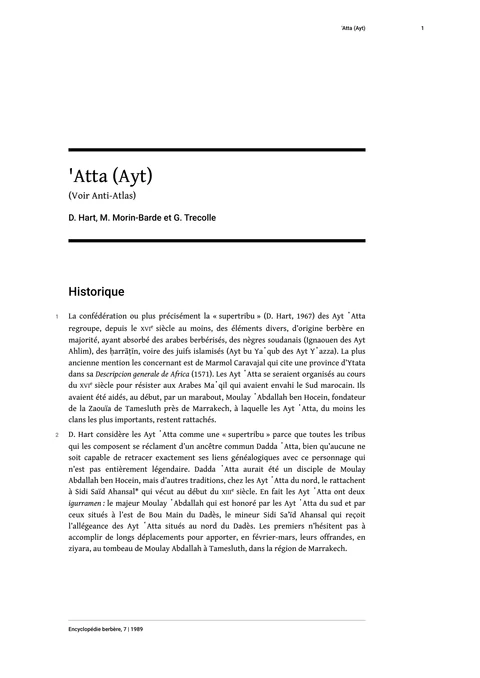
  18. ConfirmsPage reproduced — « 'Atta (Ayt) », § 1-2

    The Ayt ʿAtta form a “supertribe” whose tribes all claim descent from Dadda ʿAtta without being able to trace their links to him; the oldest known mention is Marmol Carvajal's (1571), and the confederation would have organised in the 16th century against the Maʿqil Arabs.

    Printed text page of the Encyclopédie berbère, PDF p. 2, § 1-2
    « D. Hart considère les Ayt ‘Atta comme une « supertribu » parce que toutes les tribus qui les composent se réclament d'un ancêtre commun Dadda ‘Atta, bien qu'aucune ne soit capable de retracer exactement ses liens généalogiques avec ce personnage qui n'est pas entièrement légendaire. »

    1989 encyclopedic entry, CC BY-NC-ND 4.0 licence for the text: the page is reproduced unmodified.

    Document :
    'Atta (Ayt) · Original document
    printed page
    printed page § 1-2 · PDF page 2
    Status
    Quotation checked on the page image · 2026-11-07
    SHA-256 fingerprint of the private capture :
    b6a35f0cf41de79eb0ef8302f1ece466e74d807b68621a986159dbed23428aec
    See the page in the reader →
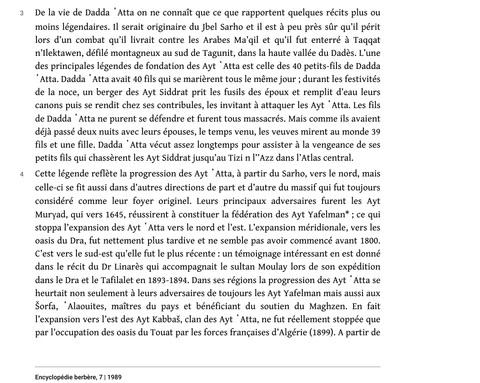
  19. ConfirmsPage reproduced — « 'Atta (Ayt) », § 4

    Around 1645, the Ayt Murghad form the Ayt Yafelman federation, which halts the Ayt ʿAtta's expansion to the north and east; the expansion towards the Draa oases “does not seem to have begun before 1800”.

    Printed text page of the Encyclopédie berbère, PDF p. 3, § 3-4 (bloc de texte)
    « Leurs principaux adversaires furent les Ayt Murγad, qui vers 1645, réussirent à constituer la fédération des Ayt Yafelman ; ce qui stoppa l'expansion des Ayt ‘Atta vers le nord et l'est. »

    Reproduction limited to the text block: the photograph at the top of the page is “all rights reserved”.

    Document :
    'Atta (Ayt) · Original document
    printed page
    printed page § 4 · PDF page 3
    Status
    Quotation checked on the page image · 2026-11-07
    SHA-256 fingerprint of the private capture :
    8b9691ffe8ea5de3a221943b508109545b526f71443beb949dbb56d14df0b973
    See the page in the reader →
  20. ConfirmsPage reproduced — « 'Atta (Ayt) », § 3

    Of Dadda ʿAtta, only “more or less legendary” accounts are known: born in the Saghro, he would have died fighting the Maʿqil; the legend of the forty grandsons expresses the Ayt ʿAtta's northward progression.

    Printed text page of the Encyclopédie berbère, PDF p. 3, § 3-4 (bloc de texte)
    « De la vie de Dadda ‘Atta on ne connaît que ce que rapportent quelques récits plus ou moins légendaires. Il serait originaire du Jbel Sarho »

    1989 encyclopedic entry, CC BY-NC-ND 4.0 licence for the text: reproduction limited to the text block, without the “all rights reserved” photograph.

    Document :
    'Atta (Ayt) · Original document
    printed page
    printed page § 3 · PDF page 3
    Status
    Quotation checked on the page image · 2026-11-07
    SHA-256 fingerprint of the private capture :
    8b9691ffe8ea5de3a221943b508109545b526f71443beb949dbb56d14df0b973
    See the page in the reader →
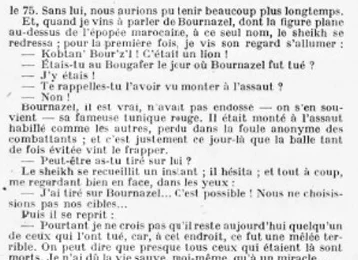
  21. NuancesShort quotationSoubrier, vers 1946, p. 1364

    Around 1946, a sheikh met by J. Soubrier says he “may” have shot at Bournazel, without having seen him go up to the assault.

    « J'ai tiré sur Bournazel... C'est possible ! Nous ne choisissions pas nos cibles... »

    I shot at Bournazel... It's possible! We did not choose our targets... (SAGHRO working translation, not validated)

    Dialogue reconstructed by the journalist thirteen years after the events; the sheikh is not named. The passage is reproduced as printed (unidentified magazine, p. 1364).

    Excerpt of the printed page (capture) — Soubrier, vers 1946, p. 1364
    Excerpt of the printed page (capture) · Crop of the quoted passage only, published with the project owner's permission (statement of 8 November 2026).
    Document :
    Bournazel, l'ancien ennemi · Original document
    printed page
    printed page 1364 · PDF page 1
    Status
    Quotation checked on the page image · 2026-11-08
    SHA-256 fingerprint of the private capture :
    eb6104835aae7820f71b268d2289d08878e5cb6c41a0f79fbcf08d6f7e411c74
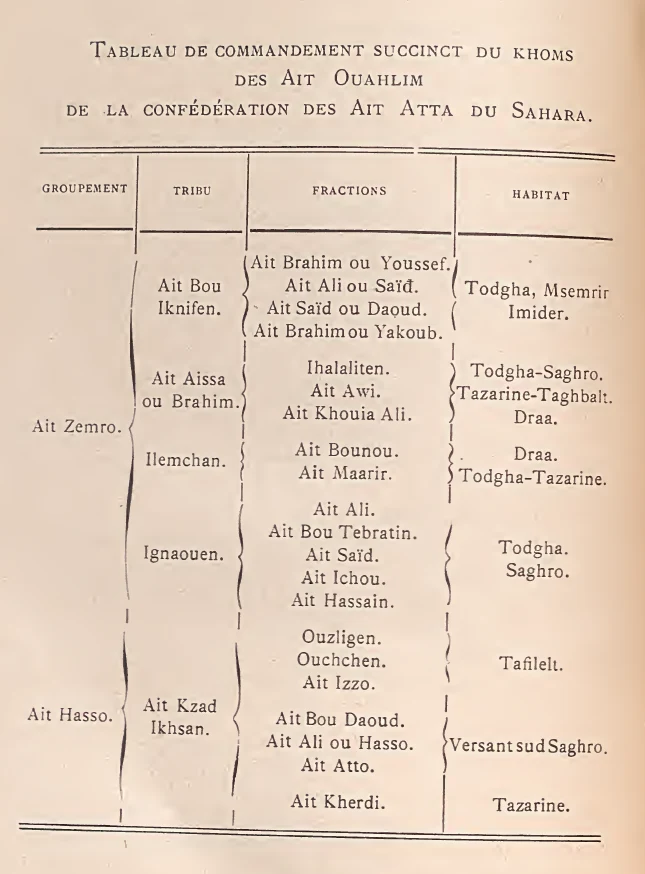
  22. DocumentsShort quotationBeaurpère (lieutenant), 1931, p. tableau hors texte (après la p. 264)

    In 1930, Beaurpère's table divides the khoms of the Aït Ouahlim into two groupings: the Aït Zemro (tribes Aït Bou Iknifen, Aït Aïssa ou Brahim, Ilemchan, Ignaouen) and the Aït Hasso (tribe Aït Kzad Ikhsan), with their sections and habitat.

    « Tableau de commandement succinct du khoms des Ait Ouahlim de la confédération des Ait Atta du Sahara. »

    Administrative table by a Native Affairs officer, appended to his note on the Todgha (Villes et tribus du Maroc, vol. IX, 1931); fieldwork in the 1960s confirms this twofold division (Hart 1984, p. 11).

    Excerpt of the printed page (capture) — Beaurpère (lieutenant), 1931, p. tableau hors texte (après la p. 264)
    Excerpt of the printed page (capture) · Crop of the quoted passage only, published with the project owner's permission (statement of 8 November 2026).
    printed page
    printed page tableau hors texte (après la p. 264) · PDF page 73 (printed page number not verified)
    Status
    Quotation checked on the page image · 2026-11-08
    SHA-256 fingerprint of the private capture :
    4b386af6d4823042fabae069a4a8220e9ba71fbafd1a39e62e58a465aea86752
  23. NuancesShort quotationBordeaux, 1935, p. 324

    Bordeaux reports the order to cover the red tunic with a “grey djellaba” (Saulay speaks of a “khaki gandoura”) and himself dismisses as “stupid and arranged remarks” the replies attributed to Bournazel. He places the bombardment “a little before seven”.

    « le lieutenant de Pothuau, lui vint transmettre l'ordre formel de recouvrir d'une djellaba grise la fameuse tunique rouge, décidément trop voyante, Bournazel aurait répondu : « C'est la chemise du condamné ? » et même qu'il aurait ajouté : « Offrez-moi la dernière cigarette ? » Propos stupides et arrangés. »

    Hagiographic biography published two years after the events by an Academician; Bordeaux transcribes médecin-major Vial's testimony. The source's vocabulary is kept in quotations.

    Document :
    Henry de Bournazel. L'épopée marocaine · Original document
    printed page
    printed page 324 · PDF page 322
    Status
    Quotation checked on the page image · 2026-11-07
    SHA-256 fingerprint of the private capture :
    1328756d767193d944ddceb314c1de81ea8b66879d71da65d0f8195c2293fa23

    Reproduction of the page not authorised: reference and short quotation only. The capture stays in the project's private archive.

  24. NuancesShort quotationBordeaux, 1935, p. 326

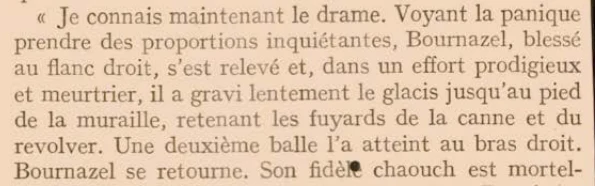
    According to médecin-major Vial, quoted by Bordeaux, the second bullet hits Bournazel in the right arm; carried back by two faithful men and a few legionnaires, he dies on the mountain after Vial's care, refusing to be taken down to the aid post.

    « Bournazel, blessé au flanc droit, s'est relevé et, dans un effort prodigieux et meurtrier, il a gravi lentement le glacis jusqu'au pied de la muraille, retenant les fuyards de la canne et du revolver. Une deuxième balle l'a atteint au bras droit. »
    Excerpt of the printed page (capture) — Bordeaux, 1935, p. 326
    Excerpt of the printed page (capture) · Crop of the quoted passage only, published with the project owner's permission (statement of 8 November 2026).
    Document :
    Henry de Bournazel. L'épopée marocaine · Original document
    printed page
    printed page 326 · PDF page 324
    Status
    Quotation checked on the page image · 2026-11-07
    SHA-256 fingerprint of the private capture :
    0a69ea48e18d2621a906bd7464f5858443f8fc48a8a0e6a0d225e53a9d295ebf
  25. CorrectsShort quotationHart, 1984, p. 176

    Assou's birth around 1890 at Taghya n-Ilimshan, previously presented as attested only by Wikipedia, is given by Hart from his family's memory.

    « Born about 1890 in the igharm of Taghya n-Ilimshan, about 20 kilometres southeast of Tinghir on the northeastern ridge of the Saghru, 'Aisa (of which "'Assu" is a diminutive) u-Ba Slam was thus about forty years old, and in his prime, at the fateful time of Bu Gafr. »

    Anthropological monograph based on fieldwork, including the testimony of Qaid ʿAli, Assou's son, and on the writings of French officers (Spillmann, Huré) which Hart translates into English. Printed page numbers inferred from folios read in the OCR.

    Source :
    Hart, 1984
    printed page
    printed page 176 · PDF page 230 (printed page number not verified)
    Status
    Quotation checked on the page image · 2026-11-07
    SHA-256 fingerprint of the private capture :
    baed3a3885756a778f6e958631d2cf2a7ad8a0d61ffb55569bb5cbea70841eae

    Reproduction of the page not authorised: reference and short quotation only. The capture stays in the project's private archive.

  26. DocumentsShort quotationHart, 1984, p. 180

    The defenders: “nearly a thousand warriors” according to a French estimate quoted by Hart, 1,200 according to Qaid ʿAli.

    « These 800 nuclear families could provide nearly a thousand warriors, all well armed and fully provided with ammunition (47). This estimate, in view of Qaid Ali's casualty figures is somewhat conservative, and the Qaid believes that a full 1,200 'Atta warriors took part in the defence of Bu Gafr. »
    Source :
    Hart, 1984
    printed page
    printed page 180 · PDF page 234 (printed page number not verified)
    Status
    Quotation checked on the page image · 2026-11-07
    SHA-256 fingerprint of the private capture :
    9b9585a81ee6cdfbfae5fd4c87c436e7690886424f91351acfa0bfbb3eb07465

    Reproduction of the page not authorised: reference and short quotation only. The capture stays in the project's private archive.

  27. NuancesShort quotationHart, 1984, p. 180

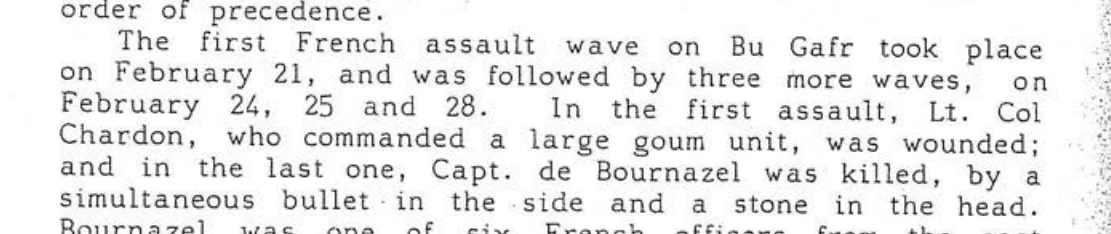
    Hart distinguishes four assault waves (21, 24, 25 and 28 February) and gives another version of Bournazel's death: a bullet in the side and a stone in the head.

    « The first French assault wave on Bu Gafr took place on February 21, and was followed by three more waves, on February 24, 25 and 28. In the first assault, Lt. Col Chardon, who commanded a large goum unit, was wounded; and in the last one, Capt. de Bournazel was killed, by a simultaneous bullet in the side and a stone in the head. »
    Excerpt of the printed page (capture) — Hart, 1984, p. 180
    Excerpt of the printed page (capture) · Crop of the quoted passage only, published with the project owner's permission (statement of 8 November 2026).
    Source :
    Hart, 1984
    printed page
    printed page 180 · PDF page 234 (printed page number not verified)
    Status
    Quotation checked on the page image · 2026-11-07
    SHA-256 fingerprint of the private capture :
    9b9585a81ee6cdfbfae5fd4c87c436e7690886424f91351acfa0bfbb3eb07465
  28. DocumentsShort quotationHart, 1984, p. 180

    Testimony of Qaid ʿAli, Assou's son, collected by Hart: 1,300 casualties among the defenders, 3,500 on the French side.

    « the figures proposed by Qaid 'Ali - 3,500 casualties on the French side, for the most part of French Moroccan troops, partisans and other 'Atta, and 1,300 casualties among the 'Atta defenders of Bu Gafr. »
    Source :
    Hart, 1984
    printed page
    printed page 180 · PDF page 234 (printed page number not verified)
    Status
    Quotation checked on the page image · 2026-11-07
    SHA-256 fingerprint of the private capture :
    9b9585a81ee6cdfbfae5fd4c87c436e7690886424f91351acfa0bfbb3eb07465

    Reproduction of the page not authorised: reference and short quotation only. The capture stays in the project's private archive.

  29. DocumentsShort quotationHart, 1984, p. 182

    On 25 March, the last defenders number 490 families, 2,900 people, 195 repeating rifles and 174 single-shot rifles.

    « Altogether, the last defenders of Bu Gafr totalled 490 nuclear families, consisting of 2,900 individuals armed with 195 repeating rifles (mostly French 1886 Model Lebels) and with 174 single-shot rifles (French 1874 Model Gras carbines) (52). »
    Source :
    Hart, 1984
    printed page
    printed page 182 · PDF page 236 (printed page number not verified)
    Status
    Quotation checked on the page image · 2026-11-07
    SHA-256 fingerprint of the private capture :
    9d4dc652c69635b641ffdf42261dbf6c66d663d8078506d52ff9fae4efba43a6

    Reproduction of the page not authorised: reference and short quotation only. The capture stays in the project's private archive.

  30. NuancesShort quotationHart, 1984, p. 182

    The aman terms according to Huré, translated by Hart, include “no war fines” and no levy of partisans for a year, absent from Saulay's list.

    « 3. no war fines; 4. complete amnesty for all acts prior to submission; and 5. in addition, a promise that the makhzan (ie. the Protectorate) would impose no corvées over and above normal taxes and that there would be no levying of partisans for a year. »
    Source :
    Hart, 1984
    printed page
    printed page 182 · PDF page 236 (printed page number not verified)
    Status
    Quotation checked on the page image · 2026-11-07
    SHA-256 fingerprint of the private capture :
    9d4dc652c69635b641ffdf42261dbf6c66d663d8078506d52ff9fae4efba43a6

    Reproduction of the page not authorised: reference and short quotation only. The capture stays in the project's private archive.

  31. DocumentsShort quotationHart, 1984, p. 183

    General Huré, translated by Hart, estimates the Saghro refugees at 7,000 and infers over 2,000 dead among the defenders, including 500 armed men; 90% of the livestock reportedly died or was raided.

    « The number of resistants who had taken refuge in the Saghru was about 7,000 and of these nearly 1,000 were warriors. Nearly 3,000 persons submitted with 'Assu u-Ba Slam, and of these some 500 were armed men. This brought the number of submissions since the beginning of operations up to 4,700. The losses of the defenders of Bu Gafr had thus been over 2,000 killed, of whom 500 were armed men. »

    Calculation by subtraction (estimated refugees minus people who came over at the end of the fighting) by a commander of the besieging army, read through an English translation: it is not a count of the dead. It contradicts the “327 martyrs” reported by Benadada.

    Source :
    Hart, 1984
    printed page
    printed page 183 · PDF page 237 (printed page number not verified)
    Status
    Quotation checked on the page image · 2026-11-07
    SHA-256 fingerprint of the private capture :
    31035ad8a540ffe77f85b1bc35c1c8c0b89003bb265d6bb2ba9fb85d980c510f

    Reproduction of the page not authorised: reference and short quotation only. The capture stays in the project's private archive.

  32. DocumentsShort quotationHart, 1984, p. 185

    According to Hart, Assou set two conditions: that the Glawi's authority not extend to the Saghro, and that customary law be fully respected.

    « 'Assu u-Ba Slam had imposed two fundamental conditions of his own during the surrender negotiation and had they not been met, he would have continued to fight. They were a guarantee from the French that the Glawi's authority would never extend to 'Attaland, or at least to the Saghru, and a further guarantee that 'Atta Customary Law would be integrally respected and upheld. »
    Source :
    Hart, 1984
    printed page
    printed page 185 · PDF page 239 (printed page number not verified)
    Status
    Quotation checked on the page image · 2026-11-07
    SHA-256 fingerprint of the private capture :
    8c2a9fa91e83dc02988ed1c034d1f1aecc025df3476b4dbfaf4b72db2ef8ca85

    Reproduction of the page not authorised: reference and short quotation only. The capture stays in the project's private archive.

  33. ContradictsShort quotationHart, 1984, p. 186

    Assou becomes acting qaid in February 1939 and remains so until his death, around 1960: Hart mentions no exile, unlike French Wikipedia.

    « before he was called on in February 1939 - the new courthouse at Igharm Amazdar having been built the preceding year - to become acting qaid, a post which he was to hold until his death twenty-one years later. His official title was amghar n-ufilla of the Ait 'Atta of the Saghru »
    Source :
    Hart, 1984
    printed page
    printed page 186 · PDF page 240 (printed page number not verified)
    Status
    Quotation checked on the page image · 2026-11-07
    SHA-256 fingerprint of the private capture :
    24a99b2574bec0c9efcd3f52918d89f2d64e6e1aba141010f994b2b34cb06714

    Reproduction of the page not authorised: reference and short quotation only. The capture stays in the project's private archive.

  34. DocumentsShort quotationBordeaux, 1935, p. 306

    Bordeaux reports that water was lacking on the mountain: the women went down at night to fetch it, because partisans and goumiers “fired less at them”, and the lack of water was, in his view, “one of the causes of the surrender”.

    « Il fallait descendre la nuit, au bas de pentes, pour chercher de l'eau. Les femmes se chargeaient de ces corvées parce que nos partisans et nos goumiers tiraient moins sur elles. Les difficultés du ravitaillement en eau devaient être une des causes de la capitulation. »

    Hagiographic biography published two years after the events by an Academician who visited Bou Gafer; the viewpoint is the French army's. The source's vocabulary (“rebels”) is kept in quotations.

    Document :
    Henry de Bournazel. L'épopée marocaine · Original document
    printed page
    printed page 306 · PDF page 304
    Status
    Quotation checked on the page image · 2026-11-08
    SHA-256 fingerprint of the private capture :
    55a1bef1f61ae190084fda4537de90d3f93e578a67fb10adc54a5927b62abd4f

    Reproduction of the page not authorised: reference and short quotation only. The capture stays in the project's private archive.

  35. DocumentsShort quotationBordeaux, 1935, p. 306

    Bordeaux's portrait of Assou Oubasslam, quoted by Wikipedia: the quotation is exact. It is a literary portrait, not the testimony of an eyewitness.

    « Le chef qui les commandait, Asso-ou-Baslam, était un homme au beau visage grave, au corps maigre et musclé, impassible et indifférent d'apparence, mais fier et plein de dignité, et qui imposait la confiance. »
    Document :
    Henry de Bournazel. L'épopée marocaine · Original document
    printed page
    printed page 306 · PDF page 304
    Status
    Quotation checked on the page image · 2026-11-08
    SHA-256 fingerprint of the private capture :
    55a1bef1f61ae190084fda4537de90d3f93e578a67fb10adc54a5927b62abd4f

    Reproduction of the page not authorised: reference and short quotation only. The capture stays in the project's private archive.

  36. DocumentsShort quotationHart, 1984, p. 180

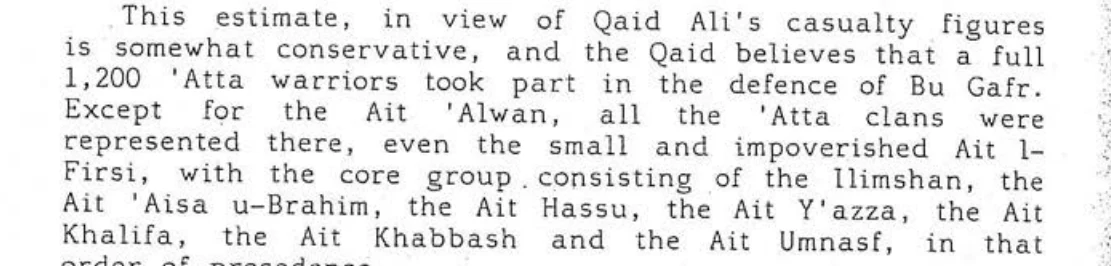
    According to Qaid ʿAli, Assou's son, about 1,200 Aït Atta fighters defended the Bou Gafer; all clans were represented except the Aït Alouane, around a core of Ilemchan, Aït ʿAïsa ou Brahim, Aït Hassou, Aït Yazza, Aït Khalifa, Aït Khebbach and Aït Oumnasf.

    « Except for the Ait 'Alwan, all the 'Atta clans were represented there, even the small and impoverished Ait l-Firsi, with the core group consisting of the Ilimshan, the Ait 'Aisa u-Brahim, the Ait Hassu, the Ait Y'azza, the Ait Khalifa, the Ait Khabbash and the Ait Umnasf, in that order of precedence. »

    Testimony collected by Hart from Assou's son in the 1960s; Hart sets it against the French calculations, which are lower (about 1,000 fighters).

    Excerpt of the printed page (capture) — Hart, 1984, p. 180
    Excerpt of the printed page (capture) · Crop of the quoted passage only, published with the project owner's permission (statement of 8 November 2026).
    Source :
    Hart, 1984
    printed page
    printed page 180 · PDF page 234
    Status
    Quotation checked on the page image · 2026-11-08
    SHA-256 fingerprint of the private capture :
    7377e1609745a43fab2aa2983e459bc5fefee1d20ef36ee23ebcfb0fe1a19ed1