Skip to content
SAGHRO

Atlas & Timeline

Timeline

From the origins of the confederation to contemporary memory. Only attested dates appear here.

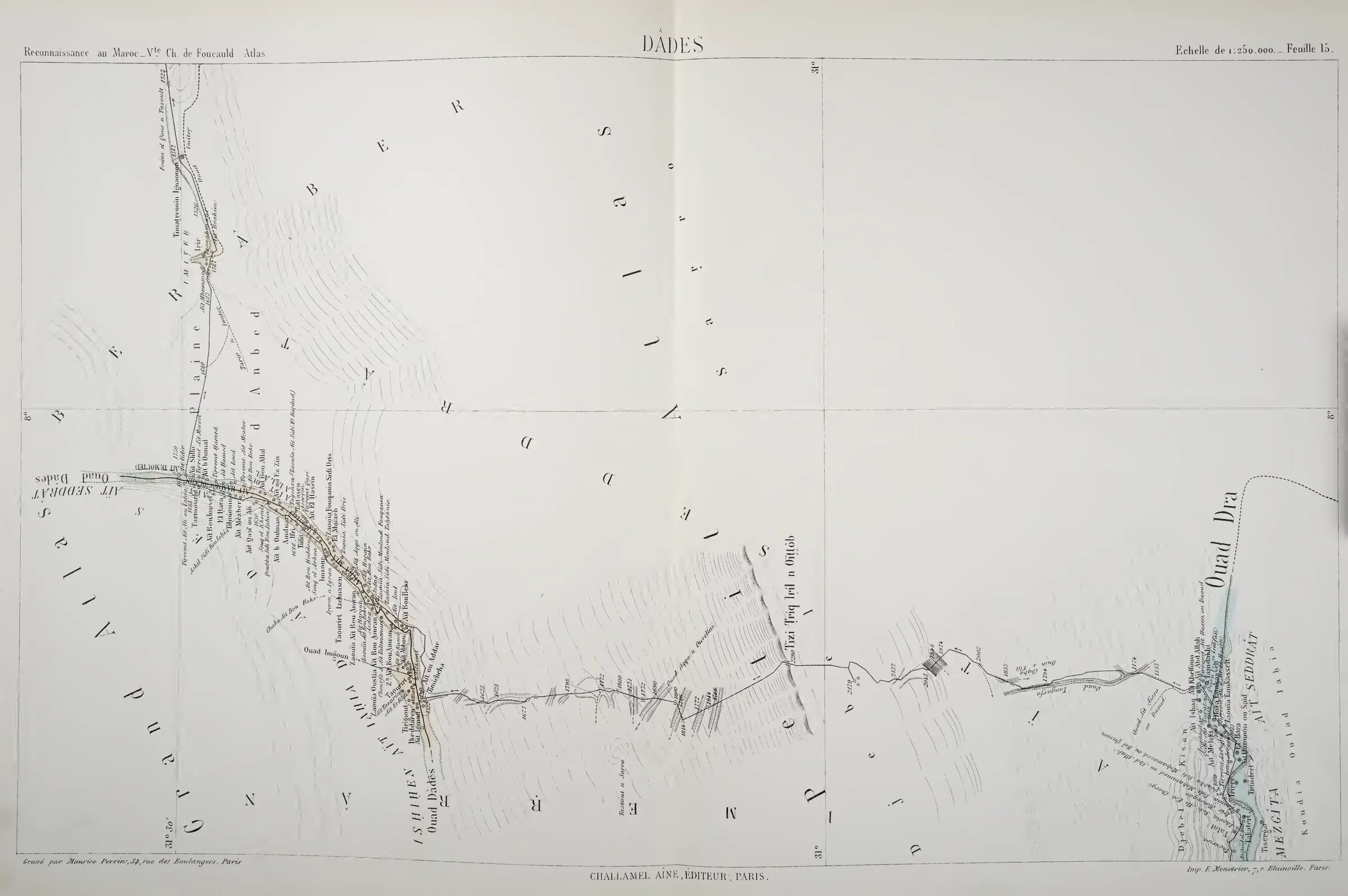
Foucauld's atlas, sheet 15 “Dâdes” (1:250,000) — Internet Archive (exemplaire du Getty Research Institute), via Wikimedia Commons, Domaine public

Periods
Themes
Status
82 / 82 events

Origins (→ 1600)

  1. 1500 – 1600A historian's interpretation

    Organisation of the confederation (sixteenth century, according to historians)

    Hart (1989) and Spillmann (1936) place the organisation of the confederation in the sixteenth century. Spillmann explains it by the will to “throw off the Arab yoke”; his translator M. Boukbout refutes this ethnic reading, inspired in his view by colonial policy, and sees political and economic reasons. No contemporary document dates the event.

    Sources — 2 sources cited · 2 independent documentary line(s)

    1. — « 'Atta (Ayt) » — § 1-2Full text consulted · Academic research
    2. Spillmann et al., 2007 — trad. p. 35-36, n. 21 du traducteur (orig. p. 40-41)Excerpts consulted · Colonial military
  2. c. 1568Confirmed by a verified source

    Death of Mulay 'Abdallah bin l-Hsain, patron saint of the Aït Atta

    According to Hart, he died in 1568 or 1571 and was buried at Tamslouht, near Marrakesh. Aït Atta tradition credits him with authorising the codification of their customary law.

    ⌖ Tamslouht

    Sources — 1 sources cited · 1 independent documentary line(s)

    1. Hart, 1966 — p. 93, n. 4Excerpts consulted · Academic research
  3. 1571Confirmed by a verified source

    First European mention of the “Ytata”

    Luis del Mármol Carvajal mentions in 1571 a “province of Ytata”, which Hart identifies as the oldest known mention of the Aït Atta (Encyclopédie berbère, 1989). Mármol's own text has not been consulted.

    Sources — 2 sources cited · 1 independent documentary line(s)

    1. Wikipedia (English) — « Ait Atta » — section HistoryFull text consulted · Encyclopedic synthesis
    2. — « 'Atta (Ayt) » — § 1-2Full text consulted · Academic research

Expansion (1600–1899)

  1. 1644Confirmed by a verified source

    Formation of the Aït Yafelman confederacy against the Aït Atta

    Hart, citing Bousquet (1956), dates to 1644 the formation of the Aït Yafelman confederacy, created “for the express purpose of combatting the Ait 'Atta”. The Aït Mirghad, its instigators according to Hart (1967), are their traditional adversaries.

    Sources — 2 sources cited · 2 independent documentary line(s)

    1. Hart, 1966 — p. 94, n. 10Excerpts consulted · Academic research
    2. Hart, 1967 — p. 83Excerpts consulted · Academic research
  2. c. 1645Contested information

    Formation of the Ait Yafelman confederation against the Ait Atta

    The Ait Merghad, Ait Hdiddou, Ait Izdeg and Ait Yahya ally to check the northward expansion of the Ait Atta; the date varies by source (c. 1645-1646, or late 17th century).

    Hart (1978) presents the alliance as “a check against the northward expansion of the Ait 'Atta”. Peyron (EB 31) reports two versions: a confederation already formed in 1645 (Henry, 1937), or an alliance prompted in the late 17th century by a letter from Moulay Ismail. The Ait Merghad are said to have formerly been part of the Ait Atta, before splitting from them around 1645.

    Sources — 4 sources cited · 4 independent documentary line(s)

    1. Hart, 1978 — p. 56-57Full text consulted · Academic research
    2. — « Merghad, Ayt (Ayt Merγad) » — § 1-3Full text consulted · Academic research
    3. — « 'Atta (Ayt) » — § 4Full text consulted · Academic research
    4. Wikipédia (français) — « Aït Yafelman »Full text consulted · Encyclopedic synthesis
  3. 1678Unverified information

    First major clash with Mulay Ismail's troops

    Encyclopedic syntheses date to 1678 the first major clash between the Aït Atta and the Alaouite sultan's forces, against the background of a revolt by the sultan's relatives supported by the Aït Atta. Not cross-checked.

    Spillmann confirms the expedition: in 1678 Moulay Ismail led his mehalla towards the Ziz, the Gheris, the Ferkla, the Todgha and the Dadès; it is the first of the Alaouite expeditions to the South that he lists up to 1816. He does not mention a revolt of the sultan's relatives.

    Sources — 3 sources cited · 1 independent documentary line(s)

    1. Wikipedia (English) — « Ait Atta »Full text consulted · Encyclopedic synthesis
    2. Wikipédia (français) — « Aït Atta »Full text consulted · Encyclopedic synthesis
    3. Spillmann et al., 2007 — trad. p. 35, n. 20 de l'auteur et du traducteur (orig. p. 41)Excerpts consulted · Colonial military
  4. 1709 – 1887Unverified information

    Expeditions to the Touat, Gourara and Tidikelt (1709, 1864, 1887)

    Spillmann reports that the memory of the expeditions of the Bni Mhammed, allies of the Aït Khebbach, to the oases of the Touat, Gourara and Tidikelt in 1709, 1864 and 1887 is still alive around 1930; he also writes that before the occupation of the Algerian oases the Aït Atta levied periodic dues there. Single source.

    Sources — 1 sources cited · 1 independent documentary line(s)

    1. Spillmann et al., 2007 — trad. p. 32, 80 (orig. p. 36, 95-96)Excerpts consulted · Colonial military
  5. c. 1724 – 1725Confirmed by a verified source

    Makhzen expedition to the Draa (around 1724-1725)

    At the end of Moulay Ismail's reign, a new expedition is sent towards the Draa, after the one of 1678 towards the Ziz, the Gheris, the Ferkla, the Todgha and the Dadès (Spillmann, note 20).

    Sources — 1 sources cited · 1 independent documentary line(s)

    1. Spillmann et al., 2007 — trad. p. 35, n. 20 de l'auteur et du traducteur (orig. p. 41)Excerpts consulted · Colonial military
  6. 1730Confirmed by a verified source

    Moulay Abdallah tries to restore his authority in the Draa (1730)

    According to Spillmann, Moulay Abdallah, whose power was weak, tried in 1730 to restore his authority in the Draa; the translator adds the harka led the same year by Moussa al-Jirari.

    Sources — 1 sources cited · 1 independent documentary line(s)

    1. Spillmann et al., 2007 — trad. p. 35, n. 20 de l'auteur et du traducteur (orig. p. 41)Excerpts consulted · Colonial military
  7. 1769 – 1784Confirmed by a verified source

    Expeditions of Sidi Mohammed ben Abdallah to the South (1769-1784)

    Spillmann dates a first intervention in the Tafilalet to 1757 and an expedition led by the sultan to 1784. His translator doubts the 1757 date, the year of accession, and gives the following chronology: a harka in 1769 under the pasha Saïd ben al-Ayyachi, another towards the Saghro in 1777 under Moulay Ali ben al-Fudayl, one towards the Tafilalet in 1783 under the vizier Abu al-Qasim al-Zayani, then the expedition of the sultan himself.

    ⌖ Jbel Saghro

    Sources — 1 sources cited · 1 independent documentary line(s)

    1. Spillmann et al., 2007 — trad. p. 35, n. 20 de l'auteur et du traducteur (orig. p. 41)Excerpts consulted · Colonial military
  8. 1801 – 1816Confirmed by a verified source

    Moulay Slimane's expeditions to the Draa and the Tafilalet (1801-1816)

    Moulay Slimane sent his troops towards the Draa and the Tafilalet in 1801 and 1803 (Spillmann) (1801 towards the Draa and 1815 towards the Tafilalet according to the translator) then in 1816 toured the southern slope of the Atlas at their head. In 1930, Beaurpère noted at Ras Staff, at the confluence of the Todgha and the Ichem, cairns pointed out as the sites of the camps of the mehallas of Moulay Slimane and Moulay Hassan.

    Sources — 2 sources cited · 2 independent documentary line(s)

    1. Spillmann et al., 2007 — trad. p. 35, n. 20 de l'auteur et du traducteur (orig. p. 41)Excerpts consulted · Colonial military
    2. Beaurpère (lieutenant), 1931 — p. 264Excerpts consulted · Colonial military
  9. 1818Unverified information

    Destruction of Sijilmasa attributed to the Aït Khabbash

    According to Wikipedia, during a conflict with the Aït Izdeg, the Aït Khabbash destroyed Sijilmasa, an already declining caravan city, in 1818. Not cross-checked.

    Sources — 1 sources cited · 1 independent documentary line(s)

    1. Wikipédia (français) — « Aït Atta » — section HistoireFull text consulted · Encyclopedic synthesis
  10. 1883 – 1884Confirmed by a verified source

    Charles de Foucauld crosses the western Saghro

    During his 1883-1884 reconnaissance, Foucauld surveyed his route from the Drâa (Tamnougalt) to the Dadès, then the Todgha and the Ferkla. On his map, the east of the massif remains a blank bearing only the name “Djebel Sarro”.

    ⌖ Tamnougalt (Mezguita)⌖ Boumalne Dades⌖ Tinghir⌖ Jbel Saghro

    Sources — 1 sources cited · 1 independent documentary line(s)

    1. Foucauld, 1888 — Atlas, feuilles 15 et 16Excerpts consulted · Colonial literature
  11. 1883Unverified information

    Battle of Tilouine against the Aït Yafelman (spring 1883)

    According to a note by Spillmann, in spring 1883 an Aït Atta harka of 8,000 foot and 600 horse faced the Aït Yafelman on the edge of the Tilouine palm grove, between the Gheris and the Jorf; the Aït Atta were defeated and lost 1,600 men. Figures from a single source, not cross-checked.

    Reported figures

    Aït Atta harka8 000 fantassins, 600 cavaliersSpillmann et al., 2007Unverified information
    Aït Atta losses1 600Spillmann et al., 2007Unverified information

    Figures are attributed to their source, never merged or averaged.

    Sources — 1 sources cited · 1 independent documentary line(s)

    1. Spillmann et al., 2007 — trad. p. 37, n. 24 de l'auteur (orig. p. 43)Excerpts consulted · Colonial military

Colonial advance (1900–1932)

  1. 1899Unverified information

    French occupation of the Touat, first contacts with the Aït Khabbash

    According to English Wikipedia, the occupation of the Touat at the end of 1899 brought the Aït Khabbash, a nomadic Aït Atta section, into contact with the French. Not cross-checked.

    Sources — 1 sources cited · 1 independent documentary line(s)

    1. Wikipedia (English) — « Ait Atta » — section Conflict with the FrenchFull text consulted · Encyclopedic synthesis
  2. 1907Confirmed by a verified source

    Occupation of Boudenib: the Aït Atta pushed westwards (1907)

    After the occupation of the Algerian oases (1902) and of Boudenib (1907), Spillmann writes, the Aït Atta, pushed westwards, turned their efforts to the Dadès and the Draa, where they then quarrelled among themselves over the conquered lands. The Aït Khebbach and the Bni Mhammed fought the French troops at Boudenib and in the Tafilalet from 1907.

    Sources — 1 sources cited · 1 independent documentary line(s)

    1. Spillmann et al., 2007 — trad. p. 37, 80 (orig. p. 42-43, 95)Excerpts consulted · Colonial military
  3. 1912Unverified information

    Establishment of the French Protectorate in Morocco

    The Protectorate was established in 1912, with Lyautey as the first Resident General. A military conquest, known as “pacification”, began and ended in 1934. A matter of general knowledge, attested in this version by encyclopedic syntheses only.

    Sources — 2 sources cited · 2 independent documentary line(s)

    1. Wikipédia (français) — « Henri de Bournazel » — section MarocFull text consulted · Encyclopedic synthesis
    2. Wikipédia (français) — « Pacification du Maroc »Excerpts consulted · Encyclopedic synthesis
  4. 1918Unverified information

    Failure of a “Franco-Glaoui” attempt in the Todgha

    The Wikipedia articles mention for 1918 a military attempt by the Glaoui, backed by the French, repelled in the Todgha valley. Unreferenced.

    ⌖ Tinghir

    Sources — 2 sources cited · 2 independent documentary line(s)

    1. Wikipédia (français) — « Assou Oubasslam »Full text consulted · Encyclopedic synthesis
    2. Wikipédia (français) — « Bataille de Bougafer » — section PrécédentsFull text consulted · Encyclopedic synthesis
  5. 1920Confirmed by a verified source

    Glaoui harka against the Aït Atta as far as Imiter

    In his chronological landmarks, Bounfour notes: “1920: Glaoui harka against the Ayt 'Atta. It reached Imiter and Trimatriwn south of Boulmane.”

    ⌖ Imider⌖ Boumalne Dades

    Sources — 1 sources cited · 1 independent documentary line(s)

    1. Bounfour, 1989 — p. 91Full text consulted · Academic research
  6. 1923Confirmed by a verified source

    The Ait Atta n-Umalu come under Protectorate control

    Bounfour dates to 1923 the passage under Protectorate control (“submission”) of the Aït Atta “of the shade”, settled north of the sub-Atlas furrow, together with that of Sidi Mha, head of the Ahansal zawiya.

    Sources — 1 sources cited · 1 independent documentary line(s)

    1. Bounfour, 1989 — p. 92Full text consulted · Academic research
  7. c. 1926Confirmed by a verified source

    End of the regular election of a top chief (amghar n-ufilla)

    Hart writes that the Aït Atta had an elected top chief “up until 1926 or 1927”, citing Spillmann (1936, p. 61). This is in tension with the election of Assou Oubasslam as amghar n-ufilla in 1932 reported by Wikipedia.

    ⌖ Igharm Amazdar

    What do the archives say? →

    Sources — 1 sources cited · 1 independent documentary line(s)

    1. Hart, 1966 — p. 94Excerpts consulted · Academic research
  8. June 1929Confirmed by a verified source

    Fighting at Ayt Yaâqoub (High Atlas)

    The Ait Hdiddou led by Ou-Sidi of Tilmi and Zayd ou-Skounti's Ayt Ayssa Izem seriously maul the French forces, which are eventually victorious.

    Sources — 2 sources cited · 2 independent documentary line(s)

    1. — « Hadiddou » — § 8Full text consulted · Academic research
    2. — « Merghad, Ayt (Ayt Merγad) » — § 7Full text consulted · Academic research
  9. 1930Confirmed by a verified source

    Dahir institutionalising “Berber customary justice”

    Duclos stresses that the customary justice instituted by the 1930 dahir “has only very distant connections” with the tribes' real customary law.

    Sources — 1 sources cited · 1 independent documentary line(s)

    1. Duclos, 1967 — p. 24Excerpts consulted · Academic research
  10. 1931 – 1932Unverified information

    Tafilalt operations

    At the end of 1931, operations were launched in the Tafilalt; Bournazel took part and then became its administrator, according to Wikipedia.

    Sources — 1 sources cited · 1 independent documentary line(s)

    1. Wikipédia (français) — « Henri de Bournazel » — section MarocFull text consulted · Encyclopedic synthesis
  11. 15 July 1931 – 18 July 1931Confirmed by a verified source

    Tounfit: three days of fighting, then occupation

    Zayd ou-Skounti's harka (about 600 Ait Merghad and Ayt Hemmou) holds for three days under air and artillery fire, then withdraws; Tounfit is occupied. Peyron sees it as a turning point in the Atlas war.

    ⌖ Tounfit

    Reported figures

    Zayd ou-Skounti's harka≈ 600Peyron, 2013Confirmed by a verified source

    Figures are attributed to their source, never merged or averaged.

    Sources — 2 sources cited · 2 independent documentary line(s)

    1. Peyron, 2013Full text consulted · Academic research
    2. — « Merghad, Ayt (Ayt Merγad) » — § 7Full text consulted · Academic research
  12. 1932Confirmed by a verified source

    The last three “pockets” of the Central Atlas and the Saghro

    Bounfour lists for 1932 three last centres of resistance: Tazizawt (Aït Sokhman, Aït 'Abdi and fighters from other tribes), the Baddou (Aït Hdiddou, Aït Mrghad) and, in 1933, the Bou Gafer.

    Sources — 1 sources cited · 1 independent documentary line(s)

    1. Bounfour, 1989 — p. 92Full text consulted · Academic research
  13. 1932Contested information

    Assou Oubasslam placed at the head of the resistance

    Encyclopedic syntheses report that in 1932, gathered at Taghya, the sections still fighting elected Assou Oubasslam amghar n-ufilla. The date and title are debated in the light of Hart.

    What do the archives say? →

    Sources — 4 sources cited · 4 independent documentary line(s)

    1. Wikipédia (français) — « Assou Oubasslam »Full text consulted · Encyclopedic synthesis
    2. Wikipedia (English) — « Assou Oubasslam »Full text consulted · Encyclopedic synthesis
    3. Wikipédia (français) — « Aït Atta »Full text consulted · Encyclopedic synthesis
    4. Saulay, 1983 — p. 62Full text consulted · Colonial military
  14. 22 August 1932 – 13 September 1932Contested information

    Siege of Tazizaout

    About a thousand fighters (Ait Sokhman, Ait Yahya, Ait Hdiddou, refugees from the Middle Atlas) hold the Tazizaout for nearly a month; hunger and thirst overcome them. Dates vary by source.

    Peyron (2013) dates the start to 22 August 1932 and the official capitulation to 13 September, some defenders holding out a week longer; Yabiladi gives “20 August to 10 September 1932”. Survivors join the Ait Hdiddou, then the Baddou. The French Wikipedia article associates Mouha ou Hammou Zayani, who died in 1921, with this siege: an anachronism.

    Reported figures

    Entrenched fighters≈ 1 000Peyron, 2013Confirmed by a verified source

    Figures are attributed to their source, never merged or averaged.

    Sources — 3 sources cited · 2 independent documentary line(s)

    1. Peyron, 2013Full text consulted · Academic research
    2. Benargane, 2025Full text consulted · Moroccan press
    3. Wikipédia (français) — « Bataille de Tazizaoute »Full text consulted · Encyclopedic synthesis
  15. November 1932Confirmed by a verified source

    Encirclement of the Saghro after the November 1932 operations

    According to Gérardin, since the November 1932 operations the Saghro massif, held by “a thousand irreducible warriors”, was encircled and served as a base for raids into the zone controlled by the Protectorate.

    ⌖ Jbel Saghro

    Sources — 1 sources cited · 1 independent documentary line(s)

    1. Gérardin, 1987 — p. 42Full text consulted · Colonial military

Bougafer (1933)

  1. February 1933Confirmed by a verified source

    Order to “reduce” the Saghro

    “In February 1933, the order arrived to proceed with the reduction of this dissident patch” (Gérardin). Two mobile groups converged: General Catroux's, from Marrakesh, to the west; General Giraud's, from the Confins, to the east.

    ⌖ Jbel Saghro

    Sources — 1 sources cited · 1 independent documentary line(s)

    1. Gérardin, 1987 — p. 42Full text consulted · Colonial military
  2. February 1933Contested information

    The forces involved: incompatible figures

    Gérardin speaks of “a thousand irreducible warriors”; Wikipedia gives 7,000 Aït Atta including 1,200 warriors, or “7,000 to 12,000” men and women, against “80,000” or “82,000” men on the French side: a figure the article itself flags as dubious and that its own order of battle does not support.

    ⌖ Bou Gafer massif (combat area)

    Reported figures

    Aït Atta fighters« un millier »Gérardin, 1987Confirmed by a verified source
    Aït Atta encircled / of whom warriors7 000 / 1 200Wikipédia (français) — « Aït Atta »Unverified information
    Aït Atta men and women7 000 à 12 000Wikipédia (français) — « Bataille de Bougafer »Unverified information
    French and auxiliary forces« 80 000 » (signalé douteux par l'article)Wikipédia (français) — « Bataille de Bougafer »Contested information
    French forces / aircraft82 000 / 44 (« réf. souhaitée »)Wikipédia (français) — « Assou Oubasslam »Unverified information
    Squadrons engaged4Wikipédia (français) — « Bataille de Bougafer »Unverified information

    Figures are attributed to their source, never merged or averaged.

    What do the archives say? →

    Sources — 4 sources cited · 4 independent documentary line(s)

    1. Gérardin, 1987 — p. 42Full text consulted · Colonial military
    2. Wikipédia (français) — « Bataille de Bougafer »Full text consulted · Encyclopedic synthesis
    3. Wikipédia (français) — « Aït Atta »Full text consulted · Encyclopedic synthesis
    4. Wikipédia (français) — « Assou Oubasslam »Full text consulted · Encyclopedic synthesis
  3. 11 February 1933 – 15 February 1933Contested information

    Start of operations: four dates depending on the source

    The start of the battle is dated 11 February (Wanaim's title, 2024), 12 February (engagement of the 14th goum according to a unit history), 13 February (Wikipedia, Wikidata) or 15 February (Bounfour, 1989). These dates may refer to different moments: first movements, first fighting or investment of the massif.

    ⌖ Jbel Saghro

    Reported figures

    Start11 février 1933Wanaim, 2024Confirmed by a verified source
    Start (14th goum)12 février 1933les-tirailleurs.frUnverified information
    Start13 février 1933Wikipédia (français) — « Bataille de Bougafer »Unverified information
    Start15 février 1933Bounfour, 1989Confirmed by a verified source

    Figures are attributed to their source, never merged or averaged.

    What do the archives say? →

    Sources — 8 sources cited · 6 independent documentary line(s)

    1. Wanaim, 2024 — titreBibliographic record only · Academic research
    2. les-tirailleurs.fr — extrait indexéAbstract / detailed record consulted · Colonial military
    3. Wikipédia (français) — « Bataille de Bougafer » — introductionFull text consulted · Encyclopedic synthesis
    4. Bounfour, 1989 — p. 92Full text consulted · Academic research
    5. — « Anti-Atlas » — § 37Full text consulted · Academic research
    6. Saulay, 1983 — p. 60Full text consulted · Colonial military
    7. Benadada, 1999 — § 6Full text consulted · Moroccan historiography
  4. 11 February 1933 – 25 March 1933Contested information

    The human toll: contradictory estimates

    No verified count exists. The estimates consulted diverge: over 2,000 killed among the defenders, including 500 armed men, according to a calculation by General Huré translated by Hart; 1,300 casualties among the defenders and 3,500 on the French side according to Qaid ʿAli, Assou's son (Hart); “327 martyrs”, including 117 women, according to Benadada. On the French side, Saulay gives the tolls of two days (22 killed on 23 February, 64 on the 28th). A Reuter dispatch of 22 August 1933, relaying estimates from L'Humanité, speaks of about 3,000 dead in the Saghro area since the operations began, without distinguishing sides (see the international press).

    ⌖ Bou Gafer massif (combat area)

    The French figure of 1,800 rank-and-file seems incompatible with Gérardin's detailed account, which lists the officers killed one by one. The figure of 4,000 civilian casualties comes with no reference. Military registers (“Mémoire des hommes”) and operational reports held by the Service historique de la Défense would make it possible to check French losses; Aït Atta losses call for research in oral and local sources.

    Reported figures

    Moroccans killed (of whom women)327 (127)Wikipédia (français) — « Bataille de Bougafer »Unverified information
    French losses (sergeant's interview)16 officiers, 85 sous-officiers, 1 800 hommesWikipédia (français) — « Bataille de Bougafer »Contested information
    Civilian casualties4 000Wikipedia (English) — « Assou Oubasslam »Unverified information
    Moroccan dead, including 117 women (Benadada, after Maazouzi and Alaoui 1987)327Benadada, 1999Unverified information
    “Martyrs” (Arabic Wikipedia, after an article by Jamil Hamdaoui)1 300ويكيبيديا (العربية) — « معركة بوغافر »Unverified information

    Figures are attributed to their source, never merged or averaged.

    What do the archives say? →

    Sources — 8 sources cited · 8 independent documentary line(s)

    1. Wikipédia (français) — « Bataille de Bougafer »Full text consulted · Encyclopedic synthesis
    2. Wikipedia (English) — « Assou Oubasslam »Full text consulted · Encyclopedic synthesis
    3. Gérardin, 1987Full text consulted · Colonial military
    4. Benadada, 1999 — § 6, n. 6Full text consulted · Moroccan historiography
    5. Saulay, 1983 — p. 57-59Full text consulted · Colonial military
    6. Hart, 1984 — p. 180, 183Excerpts consulted · Academic research
    7. Groote verliezen in Marokko. Cijfers van de „Humanité”, 1933 — p. 2Full text consulted · Foreign press
  5. 13 February 1933 – 14 February 1933Unverified information

    Skirmishes: mules captured and aircraft shot down

    According to Wikipedia, the day after the harkas moved off (night of 12-13 February), an Aït Atta group captured 117 loaded mules from a Legion company (six legionnaires killed), and an aircraft of the 37th aviation regiment was shot down, its crew killed. Not cross-checked.

    ⌖ Jbel Saghro

    Reported figures

    Mules captured117Wikipédia (français) — « Bataille de Bougafer »Unverified information
    Legionnaires killed6Wikipédia (français) — « Bataille de Bougafer »Unverified information

    Figures are attributed to their source, never merged or averaged.

    Sources — 1 sources cited · 1 independent documentary line(s)

    1. Wikipédia (français) — « Bataille de Bougafer » — section DéroulementFull text consulted · Encyclopedic synthesis
  6. 13 February 1933 – 20 February 1933Confirmed by a verified source

    Eight days of delaying actions, then retreat into the Bou Gafer

    “After eight days of delaying actions, the Aït Atta, pushed from all sides by converging columns, took refuge in the narrow Bou Gafer massif, a veritable natural fortress” (Gérardin).

    ⌖ Bou Gafer massif (combat area)

    Sources — 1 sources cited · 1 independent documentary line(s)

    1. Gérardin, 1987 — p. 42Full text consulted · Colonial military
  7. 15 February 1933Unverified information

    Fighting at Tizi n'Oulili and first requests for aman

    According to Wikipedia, on 15 February fighting took place at Tizi n'Oulili; the goums suffered heavy losses, the harkas advanced towards the Imsadene basin and the Aït Atta fighters fell back on the Bou Gafer; some families asked for aman. Places not located; not cross-checked.

    ⌖ Jbel Saghro

    Sources — 1 sources cited · 1 independent documentary line(s)

    1. Wikipédia (français) — « Bataille de Bougafer » — section DéroulementFull text consulted · Encyclopedic synthesis
  8. 16 February 1933 – 17 February 1933Unverified information

    Huré takes command in the field; Giraud's plane accident

    According to Wikipedia, faced with the cliffs of the “Needles plateau”, Huré took command on the spot and divided the deployment into two sub-sectors (Catroux, Giraud); after a conference, Giraud's plane overturned during a forced landing and the general was injured. Not cross-checked.

    ⌖ Bou Gafer massif (combat area)

    Sources — 1 sources cited · 1 independent documentary line(s)

    1. Wikipédia (français) — « Bataille de Bougafer » — section DéroulementFull text consulted · Encyclopedic synthesis
  9. 18 February 1933Confirmed by a verified source

    120 tents of the Ait Yazza obtain the aman

    According to Saulay, some fractions made contact three times and then broke off talks; on 18 February, 120 Ait Yazza tents asked for and obtained the aman.

    ⌖ Bou Gafer massif (combat area)

    Sources — 1 sources cited · 1 independent documentary line(s)

    1. Saulay, 1983 — p. 58Full text consulted · Colonial military
  10. 20 February 1933Unverified information

    Foothold south-east of the Needles plateau

    According to Wikipedia, on 20 February the attackers gained a foothold in the south-eastern part of the Needles plateau, for gains described as “insignificant”; 11 regulars and auxiliaries were killed. Not cross-checked.

    ⌖ Bou Gafer massif (combat area)

    Reported figures

    Regulars and auxiliaries killed11Wikipédia (français) — « Bataille de Bougafer »Unverified information

    Figures are attributed to their source, never merged or averaged.

    Sources — 1 sources cited · 1 independent documentary line(s)

    1. Wikipédia (français) — « Bataille de Bougafer » — section DéroulementFull text consulted · Encyclopedic synthesis
  11. 21 February 1933Confirmed by a verified source

    Capture of the peak called “la Chapelle”

    After “a climb worthy of mountaineering”, the Bournazel sub-group, spearhead of Giraud's troops, seized a steep peak topped by a pinnacle, “la Chapelle” (peak 1). One officer and two NCOs were killed (Gérardin).

    ⌖ Bou Gafer massif (combat area)

    Reported figures

    Killed on the French side (officers/NCOs)1 officier, 2 sous-officiersGérardin, 1987Confirmed by a verified source

    Figures are attributed to their source, never merged or averaged.

    Sources — 2 sources cited · 2 independent documentary line(s)

    1. Gérardin, 1987 — p. 43 et légende p. 44Full text consulted · Colonial military
    2. Wikipédia (français) — « Henri de Bournazel »Full text consulted · Encyclopedic synthesis
  12. 22 February 1933Confirmed by a verified source

    Capture of a shoulder to the north, three attempts

    Bournazel launched Lieutenant de Charette's 21st goum, supported by Lieutenant L'Aridon's partisans, against an overhanging shoulder. The objective was reached after three attempts and hand-to-hand fighting; Charette was wounded, L'Aridon killed. This shoulder, some 400 m from peak 6, became the next starting base (Gérardin).

    ⌖ Bou Gafer massif (combat area)

    Sources — 1 sources cited · 1 independent documentary line(s)

    1. Gérardin, 1987 — p. 43Full text consulted · Colonial military
  13. 23 February 1933Confirmed by a verified source

    First assault on peak 6, repelled

    According to Saulay, the attack started at 6.30 a.m.: the fezzas of Lieutenant Benedittini and Sergeant Lepape (“about 300 rifles”), supported by the 21st goum of Lieutenant Aubert, came under Aït Atta fire as soon as the mist lifted and scattered; about fifty partisans reached a ridge almost at the foot of piton 6. Around 7.15, a counter-attack on the right flank caused a general rout; Sergeant Lepape was killed “very high on the piton”. Gérardin specifies that these partisans were “Aït Atta of Alnif and the Rteb”.

    ⌖ Bou Gafer massif (combat area)⌖ Alnif

    This detail is a reminder that Aït Atta already rallied to the Protectorate fought in the French auxiliary ranks: the battle did not pit two homogeneous blocs against each other. English Wikipedia also states that the French used rallied Aït Atta against Assou Oubasslam's forces.

    Correction (Saulay read on the image of page 57): the 21st goum was commanded that day by Lieutenant Aubert, not by Benedittini, who led the fezzas; the counter-attack was not “immediate” but came around 7.15. Saulay writes that the order of the 23rd targeted “piton 8” before placing the final effort at the foot of “piton 6”: this inconsistency in the source is left as is.

    Reported figures

    Partisans engaged300 + 21e goumGérardin, 1987Confirmed by a verified source
    French and auxiliary losses (Saulay)22 tués, 41 blessés, 3 disparusSaulay, 1983Confirmed by a verified source

    Figures are attributed to their source, never merged or averaged.

    Sources — 3 sources cited · 3 independent documentary line(s)

    1. Gérardin, 1987 — p. 43Full text consulted · Colonial military
    2. Wikipedia (English) — « Ait Atta »Full text consulted · Encyclopedic synthesis
    3. Saulay, 1983 — p. 57Full text consulted · Colonial military
  14. 24 February 1933 – 25 February 1933Confirmed by a verified source

    Failure of the western assaults; the 34th goum loses half its strength

    In the west, the Catroux group launched three assaults on needles dominated by peaks 43 and 47. At dawn on the 25th, after a night climb “in the cold and the rain”, Second Lieutenant Sieurac's 34th goum was thrown back near the summits; Sieurac was killed and the goum lost half its strength. Huré judged these attacks “in no way studied” (Gérardin).

    ⌖ Bou Gafer massif (combat area)

    Reported figures

    Losses of the 34th goum« la moitié de son effectif »Gérardin, 1987Confirmed by a verified source

    Figures are attributed to their source, never merged or averaged.

    Sources — 1 sources cited · 1 independent documentary line(s)

    1. Gérardin, 1987 — p. 43Full text consulted · Colonial military
  15. 26 February 1933Confirmed by a verified source

    A twenty-four-hour truce, then refusal

    Notables representing 400 fighters ask General Giraud for a truce so their jemaas can deliberate; when it expires, a letter affirms “the will of all to resist to the end” (Saulay).

    ⌖ Bou Gafer massif (combat area)

    Reported figures

    Fighters represented by the notables400Saulay, 1983Confirmed by a verified source

    Figures are attributed to their source, never merged or averaged.

    Sources — 1 sources cited · 1 independent documentary line(s)

    1. Saulay, 1983 — p. 58Full text consulted · Colonial military
  16. 27 February 1933Unverified information

    The Resident General orders the assault resumed

    According to Wikipedia, on 27 February Resident General Lucien Saint sent Lieutenant-Colonel Alphonse Juin to order Huré to resume the assault. Not cross-checked.

    Sources — 1 sources cited · 1 independent documentary line(s)

    1. Wikipédia (français) — « Bataille de Bougafer » — section DéroulementFull text consulted · Encyclopedic synthesis
  17. 28 February 1933Confirmed by a verified source

    28 February: the assault on peak 6 fails

    Two detachments (goums, partisans, mounted Legion companies) attacked peak 6 at 7 a.m. after an artillery preparation, in light rain and an icy north-east wind. The defenders, entrenched behind low walls, repelled the assault; several officers were killed. At 12.20 p.m. all further assaults were halted (Gérardin).

    ⌖ Bou Gafer massif (combat area)

    Order of battle (Gérardin): first wave, 16th, 21st and 28th goums, motorised platoon of the 1st Foreign (Lieutenant Brencklé), mounted company of the 3rd Foreign (Captain Faucheux), with the fezaâ of the Tafilalt and the Regg as flank guard; second detachment (Captain Fouré), mounted company of the 2nd Foreign, carried platoon of the “Algeria” mounted company of the 1st Foreign, 7th and 17th goums.

    Support: six 75 mm mortars, a 65 mm mountain battery, 80 mm mountain guns of the Marrakesh militia and two 75 mm Legion batteries from the valley floor.

    Gérardin reports the deaths of Lieutenant Brencklé, Captain Faucheux (around 7.40 a.m.) and Lieutenant Binet, whose body was found “a few days later”. He describes Aït Atta women present behind the fighters, in terms shaped by the colonial gaze.

    Wikipedia puts French losses at “more than 64 killed”, including 12 legionnaires and Bournazel: an unreferenced figure. No source consulted gives Aït Atta losses for that day.

    Reported figures

    Killed on the French side« plus de 64 », dont 12 légionnairesWikipédia (français) — « Bataille de Bougafer »Unverified information
    Time of assault / halt7 h 00 / 12 h 20Gérardin, 1987Confirmed by a verified source
    French and auxiliary losses (Saulay)64 tués, 115 blessésSaulay, 1983Confirmed by a verified source
    Alnif and Mecissi fezzas (130 engaged)17 tués, 22 blessésSaulay, 1983Confirmed by a verified source

    Figures are attributed to their source, never merged or averaged.

    Sources — 3 sources cited · 3 independent documentary line(s)

    1. Gérardin, 1987 — p. 43-45Full text consulted · Colonial military
    2. Wikipédia (français) — « Bataille de Bougafer »Full text consulted · Encyclopedic synthesis
    3. Saulay, 1983 — p. 59Full text consulted · Colonial military
  18. 28 February 1933Confirmed by a verified source

    Death of Captain Henry de Bournazel

    During the assault on piton 6, Bournazel is hit once, gets up again, then is struck by a second bullet. Accounts differ on what follows: evacuated, he dies that day according to Gérardin and Wikipedia; according to médecin-major Vial's testimony transcribed by Bordeaux (1935), he dies on the mountain, having refused to be taken down to the aid post.

    ⌖ Bou Gafer massif (combat area)

    What do the archives say? →

    Sources — 5 sources cited · 4 independent documentary line(s)

    1. Gérardin, 1987 — p. 43-45Full text consulted · Colonial military
    2. Wikipédia (français) — « Henri de Bournazel »Full text consulted · Encyclopedic synthesis
    3. Saulay, 1983 — p. 58-59Full text consulted · Colonial military
    4. Bordeaux, 1935 — p. 324-327Excerpts consulted · Colonial literature
    5. Hart, 1984 — p. 179-180Excerpts consulted · Academic research
  19. 28 February 1933Confirmed by a verified source

    Assaults halted, blockade ordered

    “At 12.20, the order was given to stop all further attacks. The blockade of the massif was prescribed” (Gérardin). Saulay dates to 1 March General Huré's decision to “suspend any major attack” and tighten the blockade. Wikipedia adds that Huré now considered the Bou Gafer “impregnable”.

    ⌖ Bou Gafer massif (combat area)

    Sources — 3 sources cited · 3 independent documentary line(s)

    1. Gérardin, 1987 — p. 45Full text consulted · Colonial military
    2. Wikipédia (français) — « Bataille de Bougafer »Full text consulted · Encyclopedic synthesis
    3. Saulay, 1983 — p. 59-60Full text consulted · Colonial military
  20. 1 March 1933 – 24 March 1933Confirmed by a verified source

    The blockade: families and herds besieged, bombardment

    For about twenty-five days the Aït Atta were besieged “with families and herds” (Gérardin). Morocco's national portal mentions a “strict blockade supported by aviation”; Wikipedia mentions artillery and air bombardment, and a failed request for a truce.

    ⌖ Bou Gafer massif (combat area)

    The material conditions of the siege (access to water, food, care, the fate of the wounded) are not described in any of the sources consulted. This gap is real: it must not be filled by imagination. Military archives (daily reports) and testimonies collected locally, such as those in the documentary Bougafer 33 (2010), are the leads to explore.

    Reported figures

    Partisans kept for the blockade (Drâa and Regg harkas)1 800Saulay, 1983Confirmed by a verified source

    Figures are attributed to their source, never merged or averaged.

    Sources — 4 sources cited · 4 independent documentary line(s)

    1. Gérardin, 1987 — p. 45Full text consulted · Colonial military
    2. Portail national du Royaume du Maroc (maroc.ma)Abstract / detailed record consulted · Moroccan historiography
    3. Wikipédia (français) — « Bataille de Bougafer »Full text consulted · Encyclopedic synthesis
    4. Saulay, 1983 — p. 60Full text consulted · Colonial military
  21. 10 March 1933Confirmed by a verified source

    150 families leave the Bou Gafer

    Ait Ouanebgui and Ait Yazza families cross the lines on the side of the Drâa harka; Captain Spillmann receives them with a doctor who treats the worst affected (Saulay).

    ⌖ Bou Gafer massif (combat area)

    Saulay then attributes to Captain Spillmann, in indirect style, these thoughts before “this grim Bou Gafer, last stronghold of magnificent [misprinted in the bulletin] warriors who would rather be cut to pieces than submit. And they have their women, their children, their flocks with them... How can this massacre be stopped?”, narration by a former officer, fifty years later, not a quotation from anything Spillmann wrote.

    Reported figures

    Families crossing the lines150Saulay, 1983Confirmed by a verified source

    Figures are attributed to their source, never merged or averaged.

    Sources — 1 sources cited · 1 independent documentary line(s)

    1. Saulay, 1983 — p. 60Full text consulted · Colonial military
  22. 21 March 1933 – 24 March 1933Confirmed by a verified source

    Four days of talks between the lines

    After an hour of “oratorical jousting” on 21 March, the Ait Aïssa ou Brahim agree to talk; on the 24th, the jemaa led by Assou Oubasslam declares: “We are still at war and we are not ‘Maghzen’”, and states its conditions (Saulay).

    ⌖ Bou Gafer massif (combat area)

    On the 23rd a local truce allows about fifteen delegates to come down; Assou, who had come with them, left on seeing that the artillery was still firing. On the 24th he asked to leave the Bou Gafer with the flocks and to return freely, weapons in hand, to the transhumance routes. When Commandant Boyé replied that they would be treated like the fractions already rallied, the jemaa dispersed in protest; the intermediary Ali ou Adda and Lieutenant Lecomte finally obtained an agreement in principle. Saulay also reports that a prophecy had led the Ait Aïssa ou Brahim to elect as war chief a five-year-old child of the Ou Ghezis clan, the only survivor of his line.

    Sources — 1 sources cited · 1 independent documentary line(s)

    1. Saulay, 1983 — p. 61-62, n. 2-3Full text consulted · Colonial military
  23. 24 March 1933Confirmed by a verified source

    Negotiations between the jemaa and the officers

    Duclos writes that the last defenders of the Saghro, “led by El Haj Assou Baslam”, “negotiated their submission”. 24 March is the date given by Bounfour as the end of the armed resistance and by Wikipedia as the start of negotiations. The terms obtained are reported in divergent ways.

    ⌖ Bou Gafer massif (combat area)

    What do the archives say? →

    Sources — 5 sources cited · 5 independent documentary line(s)

    1. Duclos, 1967 — p. 23Excerpts consulted · Academic research
    2. Bounfour, 1989 — p. 92Full text consulted · Academic research
    3. Wikipédia (français) — « Bataille de Bougafer »Full text consulted · Encyclopedic synthesis
    4. Wikipédia (français) — « Assou Oubasslam »Full text consulted · Encyclopedic synthesis
    5. Saulay, 1983 — p. 61-62Full text consulted · Colonial military
  24. 25 March 1933Confirmed by a verified source

    25 March: end of the fighting and aman agreement

    “On 25 March, exhausted but magnificent, they surrendered to General Huré” (Gérardin). Saulay places the scene at the small marabout of Khouia Brahim, before Generals Huré, Giraud and Catroux, and reproduces Huré's official telegram (no. 43/PC, 25 March, 11 a.m.). 25 March is also the date given by Wanaim (2024), Wikidata and English Wikipedia.

    ⌖ Bou Gafer massif (combat area)

    What do the archives say? →

    Sources — 7 sources cited · 5 independent documentary line(s)

    1. Gérardin, 1987 — p. 45Full text consulted · Colonial military
    2. Wanaim, 2024 — titreBibliographic record only · Academic research
    3. Wikipedia (English) — « Ait Atta »Full text consulted · Encyclopedic synthesis
    4. Saulay, 1983 — p. 62-63Full text consulted · Colonial military
    5. — « Anti-Atlas » — § 41Full text consulted · Academic research
    6. Hart, 1984 — p. 182-183Excerpts consulted · Academic research

Eastern High Atlas · Baddou (1933)

  1. 1 May 1933Confirmed by a verified source

    Battle of Msedrid (Aït Hdiddou)

    According to Wikipedia, on 1 May 1933 the Aït Hdiddou inflicted a last defeat on colonial troops at Msedrid. Gérardin notes that after the Saghro, operations targeted “the unsubmitted islet of the High Atlas occupied by the Aït Hadiddou and the Aït Morrhad”.

    Sources — 3 sources cited · 3 independent documentary line(s)

    1. Wikipédia (français) — « Pacification du Maroc »Excerpts consulted · Encyclopedic synthesis
    2. Gérardin, 1987 — p. 45Full text consulted · Colonial military
    3. Peyron, 2013Full text consulted · Academic research
  2. July 1933 – August 1933Confirmed by a verified source

    Mobile groups converge on the eastern High Atlas

    From late July 1933, military groups are ordered to advance on Aghbalou n-Kerdous; Peyron names the mobile groups of Marrakech, the Confins, Tadla and Meknès.

    ⌖ Aghbalou n-Kerdous

    The 2021 commemorative dispatch speaks of “three military groups”; Yabiladi of five generals (Tadla, Meknès, Marrakech, Tinghir, Confins). No consulted source gives the exact number of units or men.

    Sources — 3 sources cited · 2 independent documentary line(s)

    1. Peyron, 2013Full text consulted · Academic research
    2. Benargane, 2025Full text consulted · Moroccan press
  3. August 1933Confirmed by a verified source

    The last stronghold of the Baddou

    Falling back from the gardens of Itto Fezzou to the Tizi n-Hamdoun and the caves of Aghbalou n-Kerdous, the fighters shut themselves in the Baddou and defend the Ouksersou peak; hunger and thirst prove decisive.

    ⌖ Jbel Baddou⌖ Aghbalou n-Kerdous

    Peyron (2013) writes that thirst was “made worse by machine-gun fire on the few water points where devoted Amazigh women were killed at night while vainly trying to bring back the precious liquid”. Yabiladi reports that General Huré had the water points seized and the defenders taken from behind (Colonel Arnaud). No consulted source gives a toll of the defenders' or civilians' losses.

    Sources — 3 sources cited · 2 independent documentary line(s)

    1. Peyron, 2013Full text consulted · Academic research
    2. Benargane, 2025Full text consulted · Moroccan press
    3. — « Merghad, Ayt (Ayt Merγad) » — § 7Full text consulted · Academic research
  4. 5 August 1933 – 6 August 1933Confirmed by a verified source

    Tizi n-Hamdoun and the Ghriss defiles

    On two consecutive days, as the vice tightens, Ait Hdiddou and Ait Merghad fighters inflict heavy losses on the Legion and the tirailleurs (Peyron 2013; single source, losses not quantified).

    Sources — 1 sources cited · 1 independent documentary line(s)

    1. Peyron, 2013Full text consulted · Academic research
  5. 25 August 1933Unverified information

    Assault of 25 August

    Yabiladi dates the final assault to 25 August and attributes to Voinot (1939) the French toll for that day: “13 killed and 31 wounded, including one officer”. Second-hand quotation, not verified in the original.

    ⌖ Jbel Baddou

    Reported figures

    French losses on 25 August (Voinot, as quoted)13 tués, 31 blessésVoinot, 1939Unverified information

    Figures are attributed to their source, never merged or averaged.

    Sources — 2 sources cited · 1 independent documentary line(s)

    1. Benargane, 2025Full text consulted · Moroccan press
    2. Voinot, 1939Known through indirect citations · Colonial military
  6. 29 August 1933Confirmed by a verified source

    End of the fighting on the Baddou

    After a last attempt to break the encirclement, Zayd ou-Skounti “ended up surrendering” (Peyron). The date of 29 August and his reception by General Giraud at Assoul are given only by Wikipedia and the press.

    ⌖ Assoul⌖ Jbel Baddou

    Sources — 3 sources cited · 2 independent documentary line(s)

    1. Peyron, 2013Full text consulted · Academic research
    2. Wikipédia (français) — « Zaïd Ou Hsaïn Ou Skounti »Full text consulted · Encyclopedic synthesis
    3. Benargane, 2025Full text consulted · Moroccan press

Protectorate (1933–1956)

  1. April 1933 – May 1933Confirmed by a verified source

    The last independent fractions rally

    Over the next two months, 550 Ait Atta families of the upper Dadès and the Imdghas declare allegiance to the Makhzen; a Native Affairs post is created at Iknioun, and the Saghro, whose battlefield is strewn with bodies and unexploded shells, is declared a “forbidden zone” for some time (Saulay).

    ⌖ Ikniouen

    Reported figures

    Families rallied (upper Dadès, Imdghas)550Saulay, 1983Confirmed by a verified source

    Figures are attributed to their source, never merged or averaged.

    Sources — 2 sources cited · 1 independent documentary line(s)

    1. Saulay, 1983 — p. 63Full text consulted · Colonial military
    2. — « Anti-Atlas » — § 42-43Full text consulted · Academic research
  2. 1934Unverified information

    Anti-Atlas campaign, end of the “pacification”

    The 1934 Anti-Atlas campaign, conducted by two operational groups (Catroux to the west, Giraud to the east), is presented by Wikipedia as the last of the conquest.

    Sources — 1 sources cited · 1 independent documentary line(s)

    1. Wikipédia (français) — « Pacification du Maroc »Excerpts consulted · Encyclopedic synthesis
  3. 1935Confirmed by a verified source

    Henry Bordeaux publishes Bournazel's biography

    Two years after Bougafer, the Academician Henry Bordeaux devoted a biography to Bournazel (Plon, 1935) that fixed in France the heroic narrative of his death.

    Sources — 2 sources cited · 1 independent documentary line(s)

    1. Bordeaux, 1935Excerpts consulted · Colonial literature
    2. Wikipédia (français) — « Henri de Bournazel » — BibliographieFull text consulted · Encyclopedic synthesis
  4. 1936Confirmed by a verified source

    Publication of Georges Spillmann's Les Aït Atta du Sahara

    The Institut des Hautes Études Marocaines published in Rabat Captain Spillmann's study, which estimates the Aït Atta population at 38,000 according to encyclopedic syntheses.

    Reported figures

    Estimated Aït Atta population38 000Wikipédia (français) — « Aït Atta »Unverified information

    Figures are attributed to their source, never merged or averaged.

    Sources — 2 sources cited · 1 independent documentary line(s)

    1. Spillmann, 1936Known through indirect citations · Colonial military
    2. Wikipédia (français) — « Aït Atta »Full text consulted · Encyclopedic synthesis
  5. 1936 – 1938Confirmed by a verified source

    Jean Robichez collects Amazigh poems on the conquest

    Between 1936 and 1938 the officer Jean Robichez collected a corpus of poems, mostly among the Aït Sokhman, about the 1927-1933 conquest; Abdallah Bounfour analysed them in 1989.

    Sources — 1 sources cited · 1 independent documentary line(s)

    1. Bounfour, 1989 — p. 91-92Full text consulted · Academic research
  6. 1936Confirmed by a verified source

    End of Zayd ou-Hmad's lone struggle

    With two or three companions, this Ait Merghad man keeps up raids until spring 1936; the adventure ends at the ksar of Tadafelt (lower Todgha).

    Sources — 2 sources cited · 2 independent documentary line(s)

    1. — « Merghad, Ayt (Ayt Merγad) » — § 7Full text consulted · Academic research
    2. Peyron, 2013Full text consulted · Academic research
  7. 1938Unverified information

    A building for the customary court of appeal at Igharm Amazdar

    Hart notes that the French administration built a building for the istinaf at Igharm Amazdar, which had become a school by 1961; Wikipedia dates its construction to 1938 (unreferenced date).

    ⌖ Igharm Amazdar

    Sources — 2 sources cited · 2 independent documentary line(s)

    1. Hart, 1966 — p. 93Excerpts consulted · Academic research
    2. Wikipédia (français) — « Aït Atta »Full text consulted · Encyclopedic synthesis
  8. February 1939Confirmed by a verified source

    Assou Oubasslam, shaykh then acting qaid

    Saulay and Hart, read on the page images, describe him after 1933 as shaykh, then acting qaid from February 1939 until his death; neither mentions an exile. French Wikipedia states on the contrary that, exiled after 1933, he was freed and appointed qaid in 1956; English Wikipedia that he remained “grand qaid” from 1933.

    What do the archives say? →

    Sources — 4 sources cited · 4 independent documentary line(s)

    1. Saulay, 1983 — p. 63Full text consulted · Colonial military
    2. Hart, 1984 — p. 186Excerpts consulted · Academic research
    3. Wikipédia (français) — « Assou Oubasslam » — section Après la résistanceFull text consulted · Encyclopedic synthesis
    4. Wikipedia (English) — « Assou Oubasslam »Full text consulted · Encyclopedic synthesis
  9. 10 July 1943Contested information

    Death of Zayd ou-Skounti

    French Wikipedia speaks of a hunting accident, then of a “very probable” assassination; Arabic Wikipedia of a commissioned assassination. No primary source consulted.

    Sources — 2 sources cited · 2 independent documentary line(s)

    1. Wikipédia (français) — « Zaïd Ou Hsaïn Ou Skounti »Full text consulted · Encyclopedic synthesis
  10. 1952 – 1953Confirmed by a verified source

    Louis-Jean Duclos's inquiry into customary justice in the Drâa

    In the Zagora district, twenty years after the conquest, Duclos collected memories of a judicial organisation for which the Aït Atta “naturally” remained nostalgic.

    Sources — 1 sources cited · 1 independent documentary line(s)

    1. Duclos, 1967 — p. 23-24Excerpts consulted · Academic research
  11. 1955Confirmed by a verified source

    A violent storm strikes Igharm Amazdar

    According to Hart, Igharm Amazdar “has never truly recovered” from a very bad storm in 1955.

    ⌖ Igharm Amazdar

    Sources — 1 sources cited · 1 independent documentary line(s)

    1. Hart, 1966 — p. 93Excerpts consulted · Academic research

Independence (1956–1999)

  1. 1956Confirmed by a verified source

    Moroccan independence and end of the customary institutions

    Igharm Amazdar functioned as the Aït Atta capital “until Moroccan independence”, Hart writes. After 1956 the customary jurisdictions were abolished; tribes and sections gave way to rural communes and caidates.

    ⌖ Igharm Amazdar

    Sources — 2 sources cited · 2 independent documentary line(s)

    1. Hart, 1966 — p. 93Excerpts consulted · Academic research
    2. Wikipédia (français) — « Aït Atta » — section Après 1956Full text consulted · Encyclopedic synthesis
  2. 1960Confirmed by a verified source

    1960 census: Igharm Amazdar has 648 inhabitants

    Based on the 1960 Moroccan census, Hart estimates the Aït Atta at between 150,000 and 200,000 people across three provinces; Igharm Amazdar then had about 100 houses and 648 permanent inhabitants.

    ⌖ Igharm Amazdar

    Reported figures

    Aït Atta (Hart's estimate, 1966)150 000 – 200 000Hart, 1966Confirmed by a verified source
    Aït Atta in 1960 (Wikipedia, after Hart)125 000 – 135 000Wikipedia (English) — « Ait Atta »Contested information

    Figures are attributed to their source, never merged or averaged.

    Sources — 1 sources cited · 1 independent documentary line(s)

    1. Hart, 1966 — p. 93Excerpts consulted · Academic research
  3. 16 August 1960Unverified information

    Death of Assou Oubasslam

    English Wikipedia dates his death to 16 August 1960 and says he was buried in his ancestors' cemetery, in the commune of Imilchan. Unreferenced date; the year is consistent with Hart's indications for 1961.

    Sources — 2 sources cited · 2 independent documentary line(s)

    1. Wikipedia (English) — « Assou Oubasslam » — section DeathFull text consulted · Encyclopedic synthesis
    2. Hart, 1966 — p. 92, n. 2Excerpts consulted · Academic research
  4. September 1961Confirmed by a verified source

    Hart photographs the qânûn of Igharm Amazdar

    In September 1961, with the agreement of the qaid of Ikniouen, Hart had a notebook of customary rules of the Aït 'Aisa of Igharm Amazdar photographed, written in Arabic with many archaic Amazigh terms, probably a 1935-1940 copy of an older document.

    ⌖ Igharm Amazdar⌖ Ikniouen

    Sources — 1 sources cited · 1 independent documentary line(s)

    1. Hart, 1966 — p. 92, 98Excerpts consulted · Academic research
  5. 1981Confirmed by a verified source

    Publication of Dadda 'Atta and his Forty Grandsons

    Hart brought together in one volume (260 pp., 20 photographs, 6 maps) his work on Aït Atta socio-political organisation, based on fieldwork in 1961-1962, 1965 and 1975.

    Sources — 2 sources cited · 1 independent documentary line(s)

    1. Peyron, 1982 — p. 149Full text consulted · Academic research
    2. Hart, 1981Bibliographic record only · Academic research
  6. 28 February 1981Confirmed by a verified source

    First annual reunion of the survivors of Bou Gafer at Ikniouen

    According to Hart, the legacy of Bou Gafer is “vigorously upheld” by the survivors: since 28 February 1981 an annual reunion has been held at Ikniouen, attended by members of the government. At the first one, Mahjoubi Aherdane, secretary general of the Mouvement populaire, gave a commemorative speech in Tamazight.

    ⌖ Ikniouen⌖ Igharm Amazdar

    Hart adds that segmentary organisation, the five-fifths system, customary law and the “capital” at Igherm Amazdar, which he regards as inseparable from this legacy, were badly eroded during the first generation after independence.

    Sources — 1 sources cited · 1 independent documentary line(s)

    1. Hart, 1984 — chap. 6, « Conclusion », 1re page (PDF p. 259 ; texte lu sur l'image)Excerpts consulted · Academic research

Today (2000 →)

  1. 2010Confirmed by a verified source

    The documentary Bougafer 33

    Directed by Ahmed Baidou from a script by Mustapha Qadery, the film draws on testimonies of local witnesses and descendants of fighters; it also broadcasts accounts by Sergeant-Major Isidore Lelong. Awarded at Martil and Agadir in 2010.

    Sources — 2 sources cited · 2 independent documentary line(s)

    1. Wikipédia (français) — « Bougafer 33 »Full text consulted · Encyclopedic synthesis
    2. Baidou et al., 2010Abstract / detailed record consulted · Oral tradition
  2. March 2026Unverified information

    A Resistance museum reported at Ikniouen

    In March 2026, ahead of the Bougafer commemoration, residents of Ikniouen and local sources quoted by Hespress said that a Resistance museum had been built and equipped, and that the former caïdat headquarters, the “qashla”, had been restored. In 2016 such a museum was only a recommendation; in 2024 residents still described it as awaited.

    ⌖ Ikniouen

    No document consulted gives the museum's official name, opening date, managing body or list of collections: SAGHRO therefore publishes neither opening hours nor descriptions of objects. The same article calls the old building both the caïdat headquarters occupied by Assou Oubasslam (caïd from 1939 until his death) and the headquarters of the resistance command.

    Sources — 3 sources cited · 3 independent documentary line(s)

    1. Aït Hssaine, 2026Excerpts consulted · Moroccan press
    2. Aït Hssaine, 2024Excerpts consulted · Moroccan press
    3. Kamal Mohamed (كمال محمد), 2016Excerpts consulted · Moroccan press
  3. 2 April 2026Confirmed by a verified source

    93rd anniversary of the battle of Bougafer

    A dispatch republished by allAfrica reports a celebration of the 93rd anniversary, presenting the battle as one of the flagship episodes of the national struggle.

    Sources — 1 sources cited · 1 independent documentary line(s)

    1. allAfrica (reprise de dépêche), 2026Abstract / detailed record consulted · Moroccan press