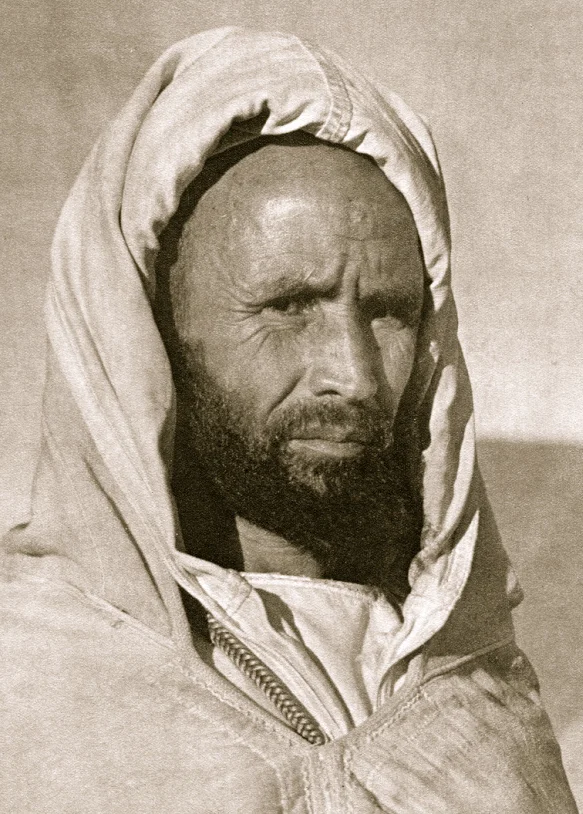
The written sources on Bougafer come almost entirely from the side besieging the massif. Yet they reveal the defenders' tenacity: Saulay, a former goum officer, speaks of “a fierce and determined adversary” who “greatly blunted” the fighting spirit of the partisans sent against him (p. 60); the command gave up assaults after 28 February and chose blockade (p. 59). Henry Bordeaux describes Assou Oubasslam as a man “proud and full of dignity, who inspired trust” (p. 306).
The few words of the defenders that survive were preserved by their adversaries. On 24 March the Aït Atta delegates declared: “We are still at war, and we are not ‘Maghzen’”, before setting their own conditions (Saulay, p. 61); according to Hart, Assou would have kept fighting had it not been guaranteed that the Glaoui would have no authority over the Saghro and that customary law would be respected (p. 185). Around 1946 an unnamed sheikh told the journalist Soubrier that he had been at Bougafer and that “at that spot it was a terrible mêlée”, reported testimony that cannot be verified.
The massif sheltered whole families. According to General Huré's count, about 7,000 people had taken refuge there, nearly 1,000 of them fighters (Hart, p. 183). It was the women who went down at night to fetch water, because the partisans and goumiers “fired less at them”, writes Bordeaux, who makes the lack of water one of the causes of the end of the fighting (p. 306). The chapter “The life of fighters and civilians” gathers what is known of the conditions of the siege.
Who defended the massif? Spillmann, who commanded one of the harkas, counts 800 households who had taken refuge in the Saghro in February 1933: a core of 300 Aït Ouahlim households (Ilemchan, Aït Aïssa ou Brahim, Aït Hassou) living in the central Saghro, 200 households from the Todgha, Taghbalt and Tazarine, and about a hundred Aït Yazza and Aït Ounebgui households driven out of the Ougnat and the Regg; he names the brothers Assou and Basso ou Baslam as the leaders of this resistance (orig. pp. 140-141). Qaid ʿAli, Assou's son, speaks of 1,200 fighters and states that all Aït Atta clans were represented except the Aït Alouane (Hart, p. 180). The war also cut through families: Ilemchan, Aït Hassou and Aït Aïssa ou Brahim served in the auxiliary harkas, and Spillmann reports that some Aït Hassou loaded their rifles with paper wads when they recognised their relatives opposite (orig. p. 142, n. 30).
What the sources leave unsaid is considerable: the names of most fighters, the real number of Aït Atta dead (the figures put forward are calculations or contradictory estimates), the wounded, the children, the lost flocks. Women hardly ever appear as actors in colonial texts, a blind spot Lahcen Oukhouya Ali points out in Spillmann's ethnography. Poetry (see Timnaḍin) and family memory are the main ways to fill these silences, with care.
Local memory also keeps figures of women. Adjou Moh, of the Aït Maarir, is known from an account published in 2016 by the journalist Maïmoun Oum Laïd from unnamed witnesses: she carried water, encouraged the fighters, then fought after her husband's death, and died in March 1933. No archive consulted mentions her; her entry presents this account for what it is, a reported oral tradition.
Assisted translation, not validated
⚠ Almost all these descriptions come from authors on the besieging side; their praise of the defenders also serves to magnify the victory they claimed. They are quoted for what they acknowledge, not as a judgement on the Aït Atta.
Sources — 7 sources cited · 7 independent documentary line(s)
- Oum Laïd, 2016Full text consulted · Moroccan press