Step 1 · Topic
Origins and expansion
A confederation that claims to have been born in the Saghro and spread, from the 16th to the 19th century, from the Drâa to the Tafilalt and up to the slopes of the Central Atlas.


Guided tours · 9 steps
Origins, confederation, institutions, law and ways of life.
Map of the Aït Atta expansion (after Dunn, 1973) — Wikimedia Commons, CC0
Step 1 · Topic
A confederation that claims to have been born in the Saghro and spread, from the 16th to the 19th century, from the Drâa to the Tafilalt and up to the slopes of the Central Atlas.
Step 2 · Dossier
A founding figure whose name the confederation bears, not a demonstrated biological ancestor. This dossier separates what the tradition tells, what memory has made of it, and what the documents allow us to establish.
Step 3 · Topic
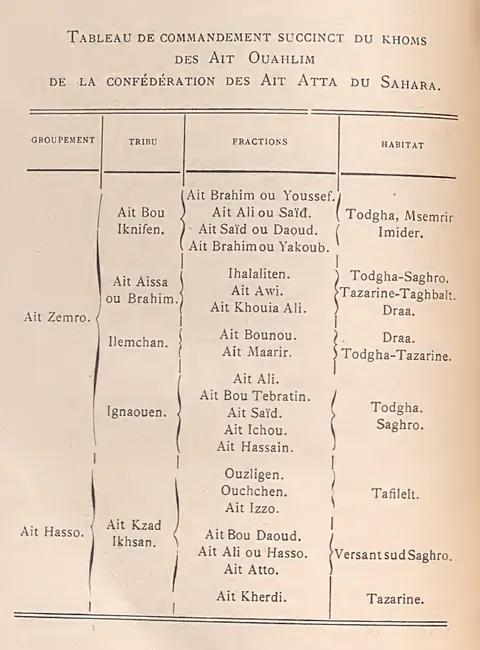
At the top of the segmentation, five groups without their own chief, whose essential function was to provide, in turn, the chief of all.
Step 4 · Topic
A top chief elected each year by those who could not be elected, removable, unpaid, and whose office lapsed around 1926-1927.
Step 5 · Topic
“London, Paris, Washington and Igharm Amazdar”: a village of a hundred houses that was the political, judicial and sacred centre of the Aït Atta.
Step 6 · Topic
Between groups and between persons, ritual commitments (an animal's blood shed, milk shared) created protection, peace and chosen kinship.
Step 7 · Topic
Collections of rules, written in Arabic with Amazigh words, organised life in the fortified villages: houses, water, theft, marriage, oath.

Step 8 · Topic
Pastoralists above all, between summer pastures in the north and winter pastures in the south, most Aït Atta were still transhumant in the 1960s.

Step 9 · Topic
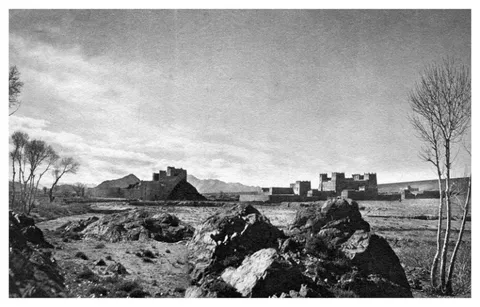
Rammed earth and stone, several storeys, guarded stores: the architecture of permanent homes.
