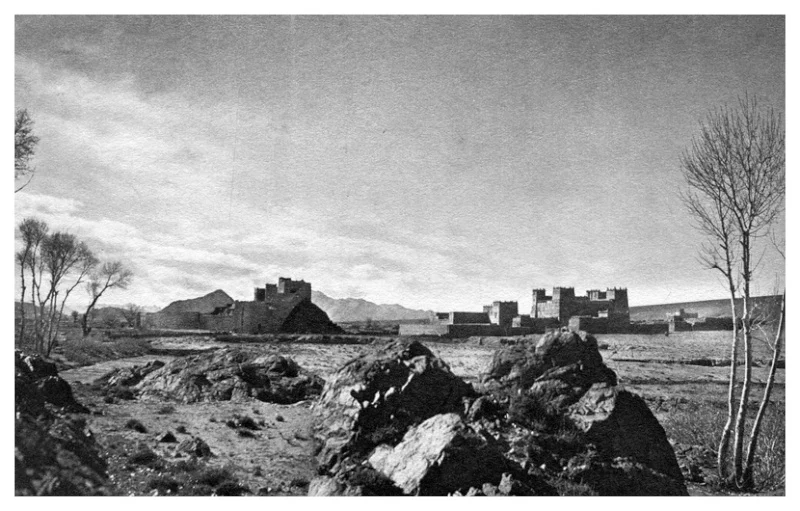
Hart reports that the Aït Atta called Igharm Amazdar their “United Nations”; a former goumier who had fought in Indochina even spoke of “London, Paris, Washington and Igharm Amazdâr”. The locality, about 25 km east of Ikniouen, housed the supreme court of appeal (istinaf).
Nearby were Admam, where the top chiefs were elected, and Tiniurshan, home of descendants of the patron saint who kept the war banner (carried by a man of the Aït Bu Tghuratin lineage of the Ilemchan clan) and the camel-skin “Agreements of the Five Fifths”.
These places lay within a sanctuary, the Tafrawt n-Ait 'Atta, where murder was absolutely forbidden. By 1961 Igharm Amazdar had only 648 inhabitants and had “never truly recovered” from a 1955 storm; the istinaf building built by the French administration was being used as a school.
In 1930 Lieutenant Beaurpère, writing from informants and a few aerial photographs, reports that the Aït Atta keep at Igherm Amazdar, in the Ichem valley, “the archives of the tribe”, and that every tribe of the confederation has its storehouse-qasba there, guarded by its representatives; letters from the sultans recognising their independence and exempting them from taxes were also said to be kept there, which no other source read allows us to verify (p. 237). Hart gives the sanctuary of the Tafrawt n-Ait ʿAtta an area of 29 km², where no shot could be fired (1984, p. 6).
Since when has Igherm Amazdar been the centre of the confederation? The sources read disagree. A tradition reported by L. Mezzine and taken up by A. M. Di Tolla sees it as a collective granary founded in the 16th century by the Aït Wahlim and the Aït Isful (Di Tolla 2016, p. 181); Hart dates its “effective” inauguration as capital to 1890 (1984, p. 7); A. Stitou traces the “court” back to the late 18th century, without citing a source (2023, p. 2). These dates do not necessarily refer to the same thing: the granary, the capital, the court.
Assisted translation, not validated
Sources — 5 sources cited · 5 independent documentary line(s)