The Ait Atta · origins
Dadda Atta: History, tradition and founding memory
A founding figure whose name the confederation bears, not a demonstrated biological ancestor. This dossier separates what the tradition tells, what memory has made of it, and what the documents allow us to establish.
- 1
Oral tradition
- 2
Collective memory
- 3
Verifiable history
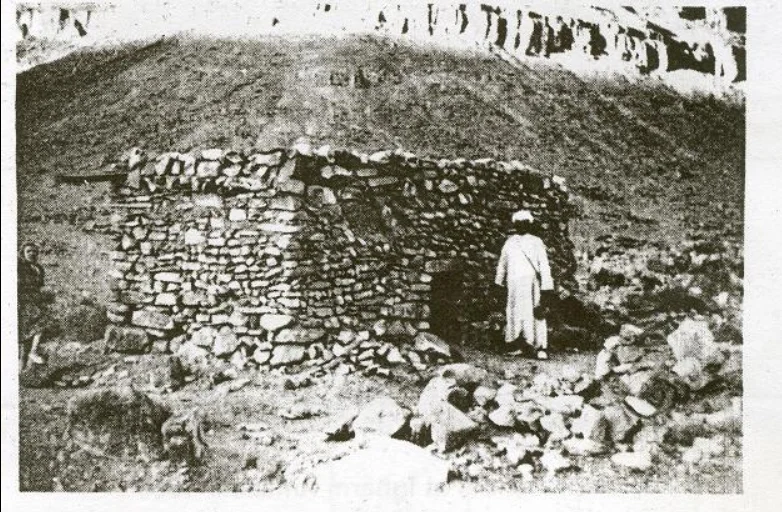
Tomb traditionally attributed to Dadda Atta, at Taqqat n-Iliktawn (Tagounite) — Publication d'origine non retrouvée (légende dans la graphie de D. M. Hart) ; fichier fourni par le titulaire du projet, Publication autorisée par le titulaire du projet (déclaration du 8 novembre 2026)
The place of memory: the tomb attributed to Dadda Atta
What the tradition tells
The stories recorded by ethnographers make Dadda 'Atta a man of the Saghro, killed fighting the Ma'qil Arabs and buried at Taqqat n-Ilektawen, a gorge south of Tagounite. His forty sons, married on the same day, were said to have been massacred by the Ait Siddrat after a shepherd filled their rifle barrels with water; their widows bore thirty-nine boys and a girl, who avenged their fathers by driving the Ait Siddrat back to the Tizi n-l-'Azz.
The tradition also links Dadda 'Atta to the saints: disciple or friend of Moulay 'Abdallah ben Hsain, founder of the zawiya of Tamesloht, for the southern Ait Atta; ally of Sidi Saïd Ahansal for the northern ones. These stories express an alliance between warrior and religious authority; they are not chronicles.
Assisted translation, not validated
Sources — 2 sources cited · 2 independent documentary line(s)
A memory that makes the confederation
All the tribes of the confederation claim Dadda 'Atta; this is why Hart speaks of a “supertribe”. But, he and his co-authors specify, none is able to trace exactly its genealogical links with this figure. The very name (Ayt 'Atta, “the people of 'Atta”) expresses a shared belonging.
The founding figure is invoked to assert autonomy: a saying recorded by Riser states that “Father 'Atta swore he would not pay, even if the Sarhro became a plain”. Another expression measures the land “from the holm oaks of the Middle Atlas to the palms of the Dra and the Tafilalet”. The memory of Dadda 'Atta is a real and lasting political and identity bond, without being genealogical proof.
Assisted translation, not validated
Sources — 2 sources cited · 2 independent documentary line(s)
What the documents establish
The oldest written mention of the Ait Atta is by Marmol Carvajal, who records a “province of Ytata” in 1571. The confederation is thought to have organised itself during the 16th century to resist the Ma'qil Arabs, with the support of Moulay 'Abdallah ben Hsain. No known contemporary document mentions Dadda 'Atta himself.
The sources describe a composite confederation: mostly Amazigh groups, having integrated Berberised Arabs, groups of sub-Saharan origin (the Ignaouen of the Ait Ahlim), haratin and converted Jewish families (the Ait bu Ya'qub of the Ait Y'azza). Its history is one of alliances, territories conquered or shared, and common institutions: the five “fifths”, the appeal court of Igherm Amazdar, the annual election of the supreme chief.
Its northward expansion was checked in the 17th century by the Ait Yafelman confederation; towards the Drâa oases it hardly began before 1800.
Assisted translation, not validated
Sources — 3 sources cited · 3 independent documentary line(s)
- Hart, 1966Excerpts consulted · Academic research
Genealogy and alliance
In the Amazigh societies of central Morocco, the language of kinship also expresses alliance: one becomes a “son of” through belonging to a group, to the territory it defends and to the institutions it shares. Hart himself calls “fictitious” the genealogies linking the neighbouring Ait Yafelman tribes to a common ancestor (“fictitious”, Hart).
This is why SAGHRO no longer writes that “the Ait Atta descend from Dadda 'Atta”, but that they “claim” him as a founding figure. This nuance does not diminish the importance of the tradition: it restores its function, which is to hold together groups of diverse origins.
Assisted translation, not validated
Sources — 2 sources cited · 2 independent documentary line(s)
Jalut (Goliath): a medieval genealogical fiction
Some Wikipedia pages present a tradition linking the Ait Atta to Jalut, the biblical Goliath, through one of his sons. Michael Peyron points out that such descents belong to the “genealogical fictions devised by the Arab chroniclers of the Maghrib and Andalusia”: “far-fetched affiliations”, “legends forged after the fact” to give the Berbers an oriental origin. Maya Shatzmiller has analysed their historiographical and political reasons.
Hart, whose books Wikipedia cites on this point, wrote in 1978 that this claim, collected by Guennoun, was “now generally abandoned or forgotten”, and that he “certainly never heard” among the Ait Atta the tradition of their descent from the sons of 'Atta. The story belongs to the history of origin myths; it is in no way genealogical proof.
Assisted translation, not validated
Cautions
⚠ “Set aside” status: biological descent through Jalut is not retained; the tradition itself is documented as a story.
Sources — 5 sources cited · 4 independent documentary line(s)
- Wikipedia (English) — « Ait Atta »Full text consulted · Encyclopedic synthesis
- Wikipédia (français) — « Aït Atta »Full text consulted · Encyclopedic synthesis
What we corrected
Earlier versions of SAGHRO wrote that the Ait Atta “all claim descent” from Dadda 'Atta; the glossary defined Dadda 'Atta as “ancestor”. These phrasings have been replaced in every language.
French Wikipedia dates Hart's 1981 book to 1961 and gives a wrong ISBN for the 1984 one; Open Library records confirm 1981 (ISBN 0-906559-06-5) and 1984 (ISBN 0-906559-15-4). SAGHRO's automated tests now flag any uncontextualised claim of biological descent.
Assisted translation, not validated
Sources — 3 sources cited · 3 independent documentary line(s)
- Wikipédia (français) — « Aït Atta »Full text consulted · Encyclopedic synthesis
- Wikipédia (français) — « Dadda Atta »Full text consulted · Encyclopedic synthesis
- Internet Archive, 2026Full text consulted · Geographic data