At the upper level the Aït Atta are divided into five “fifths” (khams khmas), three of which result from groupings of clans. Then come localised clans (taqbilt), lineages (ighs) and sub-lineages.
Hart stresses a paradox: no chief existed at the level of the fifth, yet the very function of the fifth was to provide the top chief of all Aït Atta land. He also notes a refinement specific to the Aït Atta: chiefs exist at the odd-numbered levels of the segmentation and are elected at the even-numbered levels.
According to the syntheses, the fifth also served as the nominal basis for dividing land, the actual distribution being proportional to the men present. The detail of the five groups and their subdivisions is given by Spillmann (1936, pp. 73-98), whose “skeleton” Hart praises while criticising him for misunderstanding the function of the fifths.
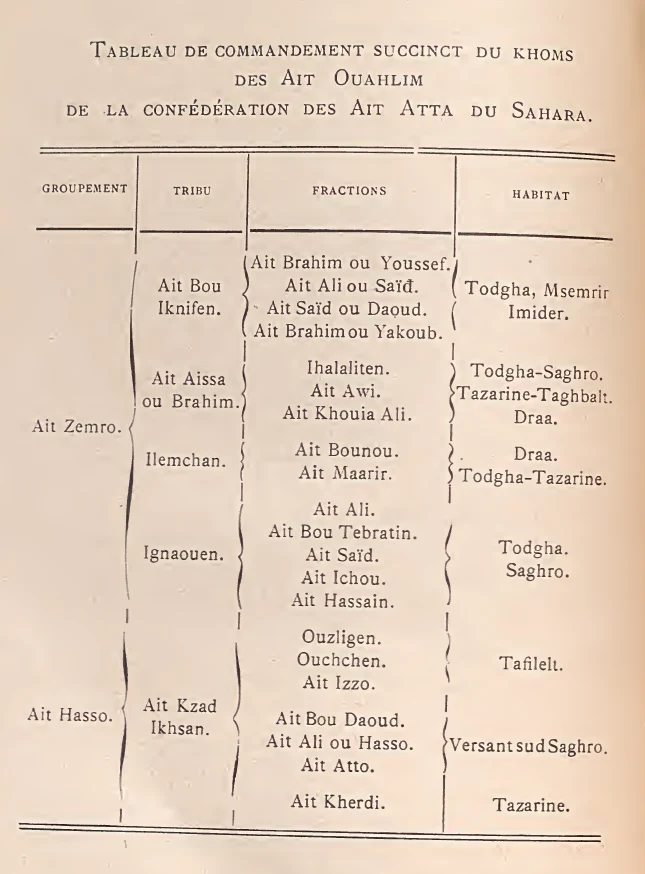
A 1930 document shows how one “fifth” was subdivided. In the table he appends to his note on the Todgha, Lieutenant Beaurpère divides the khoms of the Aït Wahlim (“Aït Ouahlim”) into two groupings: the Aït Zemro, with four tribes (Aït Bou Iknifen, Aït Aïssa ou Brahim, Ilemchan, Ignaouen), and the Aït Hasso, with the tribe of the Aït Kzad Ikhsan. Each tribe is in turn divided into sections, whose habitat stretches from the Todgha, the Imider and Msemrir to the Draa, Tazarine, the southern slope of the Saghro and the Tafilalet.
Hart finds these two subgroups in the composition of the court of Igherm Amazdar: two judges from the Aït Zimru and two from the Aït Hassu, the two “sub-fifths” of the Aït Wahlim, and two from the Aït Yaʿzza, of the khoms of the Aït ʿAïsa Mzin (1984, p. 11). That a 1930 administrative table and a 1960s survey agree strengthens the reliability of these divisions, without telling how they have changed since.
Assisted translation, not validated
⚠ Peyron (1982) considers that Hart overemphasises segmentary theory, which “counts for rather little” in the reality observed in the 1970s-1980s.
Sources — 5 sources cited · 4 independent documentary line(s)
- Wikipédia (français) — « Aït Atta »Full text consulted · Encyclopedic synthesis
- Beaurpère (lieutenant), 1931 — tableau du khoms des Aït Wahlim (page non numérotée, après la p. 264)Excerpts consulted · Colonial military