Skip to content
SAGHRO
PortraitPhotograph dedicated by Henry de Bournazel (Rif War, c. 1925-1926)Vers 1925-1926 (déduit de la dédicace ; non daté)Wikimedia CommonsProbable attribution— Identification based on a published or institutional source, without independent confirmation.

← People

Henry de Bournazel

هنري دو بورنازيل

Captain commanding a sub-group of goums and partisans in the Giraud group; killed on 28 February 1933.

Born
21 February 1898, Limoges Confirmed by a verified source
Died
28 February 1933, Bou Gafer massif (combat area) Confirmed by a verified source
French forces
Spellings
Henri de Bournazel · Henri de Lespinasse de Bournazel · l'Homme rouge · Bou vesta hamra · بورنازيل

Biography

A cavalry officer, he served in Morocco from 1921 (spahis, then goums), notably during the Rif War and the Tafilalt operations of 1931-1932. His red spahi tunic earned him the nickname “the Red Man”.

In February 1933 he commanded, according to Gérardin, the “Bournazel sub-group”, spearhead of General Giraud's troops east of the Bou Gafer: capture of the peak called “la Chapelle” on 21 February, assaults on 22 and 23 February, then the attack on peak 6 on 28 February, during which he was mortally wounded.

He then became the object of a veritable patriotic cult in France (Henry Bordeaux's biography in 1935, a Saint-Cyr class, streets named after him).

Assisted translation, not validated

Uncertainties

  • Details of his death (clothing, sequence of wounds, who fired) vary between accounts: see the dossier “The death of Bournazel”.

Sources — 2 sources cited · 2 independent documentary line(s)

  1. Wikipédia (français) — « Henri de Bournazel »Full text consulted · Encyclopedic synthesis
  2. Gérardin, 1987 — p. 42-45Full text consulted · Colonial military

In the encyclopedia

Related events

  1. 1931 – 1932Unverified information

    Tafilalt operations

    At the end of 1931, operations were launched in the Tafilalt; Bournazel took part and then became its administrator, according to Wikipedia.

    Sources — 1 sources cited · 1 independent documentary line(s)

    1. Wikipédia (français) — « Henri de Bournazel » — section MarocFull text consulted · Encyclopedic synthesis
  2. 21 February 1933Confirmed by a verified source

    Capture of the peak called “la Chapelle”

    After “a climb worthy of mountaineering”, the Bournazel sub-group, spearhead of Giraud's troops, seized a steep peak topped by a pinnacle, “la Chapelle” (peak 1). One officer and two NCOs were killed (Gérardin).

    ⌖ Bou Gafer massif (combat area)

    Reported figures

    Killed on the French side (officers/NCOs)1 officier, 2 sous-officiersGérardin, 1987Confirmed by a verified source

    Figures are attributed to their source, never merged or averaged.

    Sources — 2 sources cited · 2 independent documentary line(s)

    1. Gérardin, 1987 — p. 43 et légende p. 44Full text consulted · Colonial military
    2. Wikipédia (français) — « Henri de Bournazel »Full text consulted · Encyclopedic synthesis
  3. 22 February 1933Confirmed by a verified source

    Capture of a shoulder to the north, three attempts

    Bournazel launched Lieutenant de Charette's 21st goum, supported by Lieutenant L'Aridon's partisans, against an overhanging shoulder. The objective was reached after three attempts and hand-to-hand fighting; Charette was wounded, L'Aridon killed. This shoulder, some 400 m from peak 6, became the next starting base (Gérardin).

    ⌖ Bou Gafer massif (combat area)

    Sources — 1 sources cited · 1 independent documentary line(s)

    1. Gérardin, 1987 — p. 43Full text consulted · Colonial military
  4. 23 February 1933Confirmed by a verified source

    First assault on peak 6, repelled

    According to Saulay, the attack started at 6.30 a.m.: the fezzas of Lieutenant Benedittini and Sergeant Lepape (“about 300 rifles”), supported by the 21st goum of Lieutenant Aubert, came under Aït Atta fire as soon as the mist lifted and scattered; about fifty partisans reached a ridge almost at the foot of piton 6. Around 7.15, a counter-attack on the right flank caused a general rout; Sergeant Lepape was killed “very high on the piton”. Gérardin specifies that these partisans were “Aït Atta of Alnif and the Rteb”.

    ⌖ Bou Gafer massif (combat area)⌖ Alnif

    This detail is a reminder that Aït Atta already rallied to the Protectorate fought in the French auxiliary ranks: the battle did not pit two homogeneous blocs against each other. English Wikipedia also states that the French used rallied Aït Atta against Assou Oubasslam's forces.

    Correction (Saulay read on the image of page 57): the 21st goum was commanded that day by Lieutenant Aubert, not by Benedittini, who led the fezzas; the counter-attack was not “immediate” but came around 7.15. Saulay writes that the order of the 23rd targeted “piton 8” before placing the final effort at the foot of “piton 6”: this inconsistency in the source is left as is.

    Reported figures

    Partisans engaged300 + 21e goumGérardin, 1987Confirmed by a verified source
    French and auxiliary losses (Saulay)22 tués, 41 blessés, 3 disparusSaulay, 1983Confirmed by a verified source

    Figures are attributed to their source, never merged or averaged.

    Sources — 3 sources cited · 3 independent documentary line(s)

    1. Gérardin, 1987 — p. 43Full text consulted · Colonial military
    2. Wikipedia (English) — « Ait Atta »Full text consulted · Encyclopedic synthesis

    3. Saulay, 1983 — p. 57Full text consulted · Colonial military
  5. 28 February 1933Confirmed by a verified source

    28 February: the assault on peak 6 fails

    Two detachments (goums, partisans, mounted Legion companies) attacked peak 6 at 7 a.m. after an artillery preparation, in light rain and an icy north-east wind. The defenders, entrenched behind low walls, repelled the assault; several officers were killed. At 12.20 p.m. all further assaults were halted (Gérardin).

    ⌖ Bou Gafer massif (combat area)

    Order of battle (Gérardin): first wave, 16th, 21st and 28th goums, motorised platoon of the 1st Foreign (Lieutenant Brencklé), mounted company of the 3rd Foreign (Captain Faucheux), with the fezaâ of the Tafilalt and the Regg as flank guard; second detachment (Captain Fouré), mounted company of the 2nd Foreign, carried platoon of the “Algeria” mounted company of the 1st Foreign, 7th and 17th goums.

    Support: six 75 mm mortars, a 65 mm mountain battery, 80 mm mountain guns of the Marrakesh militia and two 75 mm Legion batteries from the valley floor.

    Gérardin reports the deaths of Lieutenant Brencklé, Captain Faucheux (around 7.40 a.m.) and Lieutenant Binet, whose body was found “a few days later”. He describes Aït Atta women present behind the fighters, in terms shaped by the colonial gaze.

    Wikipedia puts French losses at “more than 64 killed”, including 12 legionnaires and Bournazel: an unreferenced figure. No source consulted gives Aït Atta losses for that day.

    Reported figures

    Killed on the French side« plus de 64 », dont 12 légionnairesWikipédia (français) — « Bataille de Bougafer »Unverified information
    Time of assault / halt7 h 00 / 12 h 20Gérardin, 1987Confirmed by a verified source
    French and auxiliary losses (Saulay)64 tués, 115 blessésSaulay, 1983Confirmed by a verified source
    Alnif and Mecissi fezzas (130 engaged)17 tués, 22 blessésSaulay, 1983Confirmed by a verified source

    Figures are attributed to their source, never merged or averaged.

    Sources — 3 sources cited · 3 independent documentary line(s)

    1. Gérardin, 1987 — p. 43-45Full text consulted · Colonial military
    2. Wikipédia (français) — « Bataille de Bougafer »Full text consulted · Encyclopedic synthesis
    3. Saulay, 1983 — p. 59Full text consulted · Colonial military
  6. 28 February 1933Confirmed by a verified source

    Death of Captain Henry de Bournazel

    During the assault on piton 6, Bournazel is hit once, gets up again, then is struck by a second bullet. Accounts differ on what follows: evacuated, he dies that day according to Gérardin and Wikipedia; according to médecin-major Vial's testimony transcribed by Bordeaux (1935), he dies on the mountain, having refused to be taken down to the aid post.

    ⌖ Bou Gafer massif (combat area)

    What do the archives say? →

    Sources — 5 sources cited · 4 independent documentary line(s)

    1. Gérardin, 1987 — p. 43-45Full text consulted · Colonial military
    2. Wikipédia (français) — « Henri de Bournazel »Full text consulted · Encyclopedic synthesis
    3. Saulay, 1983 — p. 58-59Full text consulted · Colonial military
    4. Bordeaux, 1935 — p. 324-327Excerpts consulted · Colonial literature
    5. Hart, 1984 — p. 179-180Excerpts consulted · Academic research
  7. 1935Confirmed by a verified source

    Henry Bordeaux publishes Bournazel's biography

    Two years after Bougafer, the Academician Henry Bordeaux devoted a biography to Bournazel (Plon, 1935) that fixed in France the heroic narrative of his death.

    Sources — 2 sources cited · 1 independent documentary line(s)

    1. Bordeaux, 1935Excerpts consulted · Colonial literature
    2. Wikipédia (français) — « Henri de Bournazel » — BibliographieFull text consulted · Encyclopedic synthesis

Source pages

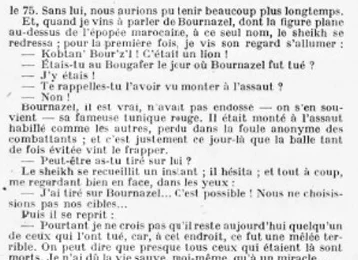
  1. NuancesShort quotationSoubrier, vers 1946, p. 1364

    Around 1946, a sheikh met by J. Soubrier says he “may” have shot at Bournazel, without having seen him go up to the assault.

    « J'ai tiré sur Bournazel... C'est possible ! Nous ne choisissions pas nos cibles... »

    I shot at Bournazel... It's possible! We did not choose our targets... (SAGHRO working translation, not validated)

    Dialogue reconstructed by the journalist thirteen years after the events; the sheikh is not named. The passage is reproduced as printed (unidentified magazine, p. 1364).

    Excerpt of the printed page (capture) — Soubrier, vers 1946, p. 1364
    Excerpt of the printed page (capture) · Crop of the quoted passage only, published with the project owner's permission (statement of 8 November 2026).
    Document :
    Bournazel, l'ancien ennemi · Original document
    printed page
    printed page 1364 · PDF page 1
    Status
    Quotation checked on the page image · 2026-11-08
    SHA-256 fingerprint of the private capture :
    eb6104835aae7820f71b268d2289d08878e5cb6c41a0f79fbcf08d6f7e411c74
  2. NuancesShort quotationBordeaux, 1935, p. 324

    Bordeaux reports the order to cover the red tunic with a “grey djellaba” (Saulay speaks of a “khaki gandoura”) and himself dismisses as “stupid and arranged remarks” the replies attributed to Bournazel. He places the bombardment “a little before seven”.

    « le lieutenant de Pothuau, lui vint transmettre l'ordre formel de recouvrir d'une djellaba grise la fameuse tunique rouge, décidément trop voyante, Bournazel aurait répondu : « C'est la chemise du condamné ? » et même qu'il aurait ajouté : « Offrez-moi la dernière cigarette ? » Propos stupides et arrangés. »

    Hagiographic biography published two years after the events by an Academician; Bordeaux transcribes médecin-major Vial's testimony. The source's vocabulary is kept in quotations.

    Document :
    Henry de Bournazel. L'épopée marocaine · Original document
    printed page
    printed page 324 · PDF page 322
    Status
    Quotation checked on the page image · 2026-11-07
    SHA-256 fingerprint of the private capture :
    1328756d767193d944ddceb314c1de81ea8b66879d71da65d0f8195c2293fa23

    Reproduction of the page not authorised: reference and short quotation only. The capture stays in the project's private archive.

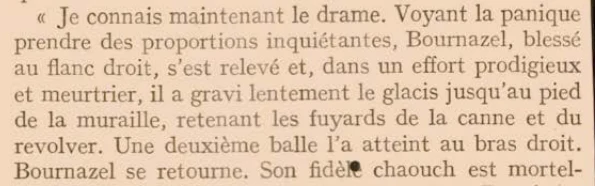
  3. NuancesShort quotationBordeaux, 1935, p. 326

    According to médecin-major Vial, quoted by Bordeaux, the second bullet hits Bournazel in the right arm; carried back by two faithful men and a few legionnaires, he dies on the mountain after Vial's care, refusing to be taken down to the aid post.

    « Bournazel, blessé au flanc droit, s'est relevé et, dans un effort prodigieux et meurtrier, il a gravi lentement le glacis jusqu'au pied de la muraille, retenant les fuyards de la canne et du revolver. Une deuxième balle l'a atteint au bras droit. »
    Excerpt of the printed page (capture) — Bordeaux, 1935, p. 326
    Excerpt of the printed page (capture) · Crop of the quoted passage only, published with the project owner's permission (statement of 8 November 2026).
    Document :
    Henry de Bournazel. L'épopée marocaine · Original document
    printed page
    printed page 326 · PDF page 324
    Status
    Quotation checked on the page image · 2026-11-07
    SHA-256 fingerprint of the private capture :
    0a69ea48e18d2621a906bd7464f5858443f8fc48a8a0e6a0d225e53a9d295ebf
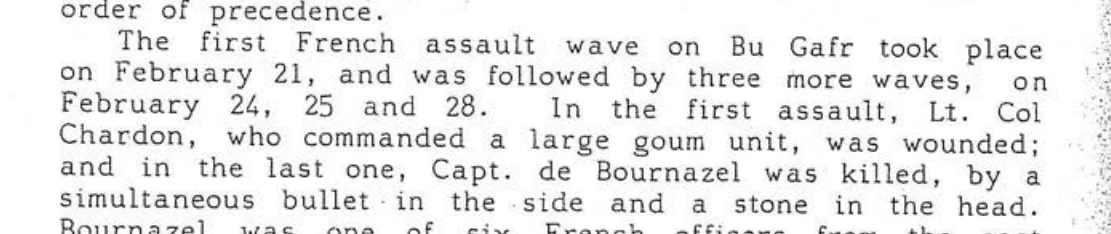
  4. NuancesShort quotationHart, 1984, p. 180

    Hart distinguishes four assault waves (21, 24, 25 and 28 February) and gives another version of Bournazel's death: a bullet in the side and a stone in the head.

    « The first French assault wave on Bu Gafr took place on February 21, and was followed by three more waves, on February 24, 25 and 28. In the first assault, Lt. Col Chardon, who commanded a large goum unit, was wounded; and in the last one, Capt. de Bournazel was killed, by a simultaneous bullet in the side and a stone in the head. »

    Anthropological monograph based on fieldwork, including the testimony of Qaid ʿAli, Assou's son, and on the writings of French officers (Spillmann, Huré) which Hart translates into English. Printed page numbers inferred from folios read in the OCR.

    Excerpt of the printed page (capture) — Hart, 1984, p. 180
    Excerpt of the printed page (capture) · Crop of the quoted passage only, published with the project owner's permission (statement of 8 November 2026).
    Source :
    Hart, 1984
    printed page
    printed page 180 · PDF page 234 (printed page number not verified)
    Status
    Quotation checked on the page image · 2026-11-07
    SHA-256 fingerprint of the private capture :
    9b9585a81ee6cdfbfae5fd4c87c436e7690886424f91351acfa0bfbb3eb07465
  5. CorrectsShort quotationSaulay, 1983, p. 57

    On 23 February, the “about 300 rifles” are the fezzas of Benedittini and Sergeant Lepape; the 21st goum supporting them is commanded by Lieutenant Aubert. The Aït Atta counter-attack comes “around 7.15”, after the partisans scatter.

    « Le capitaine de Bournazel donne ordre au lieutenant Benedittini d'attaquer à l'aube, avec sa fezza et celle du sergent Lepape, soit 300 fusils environ, soutenus par le 21e goum du lieutenant Aubert. »

    Internal inconsistency of the source, left as is: the order of the 23rd targets “piton 8”, but the narrative then places the final effort “almost at the foot of piton 6”.

    Document :
    La Koumia. Bulletin de liaison, n° 88 · Periodical issue
    Source :
    Saulay, 1983
    printed page
    printed page 57 · PDF page 61
    Status
    Quotation checked on the page image · 2026-11-07
    SHA-256 fingerprint of the private capture :
    f601bf456ce2c7deddb963cc623b8beceb2028c81299d9214a3448480567011f

    Reproduction of the page not authorised: reference and short quotation only. The capture stays in the project's private archive.

  6. ConfirmsShort quotationSaulay, 1983, p. 59

    On 28 February, Bournazel is wounded in the stomach, gets up, is wounded a second time, then carried back by two legionnaires. Saulay does not give the time of his wounds.

    « Le capitaine de Bournazel, qui vient d'être grièvement blessé au ventre, se relève avec une énergie surhumaine et se dirige vers ses goumiers qu'il sent fléchir. Blessé une seconde fois, il est abandonné par son maghzen de Branès dont il avait fait sa garde personnelle en souvenir des combats de 1925-1926 dans le Riff. »

    The heroic tone (“superhuman energy”) belongs to the officers' memory. The only times given for this phase are 7.30 (Captain Fourré reaches the saddle) and 7.45 (death of Faucheux and Brincklé).

    Excerpt of the printed page (capture) — Saulay, 1983, p. 59
    Excerpt of the printed page (capture) · Crop of the quoted passage only, published with the project owner's permission (statement of 8 November 2026).
    Document :
    La Koumia. Bulletin de liaison, n° 88 · Periodical issue
    Source :
    Saulay, 1983
    printed page
    printed page 59 · PDF page 63
    Status
    Quotation checked on the page image · 2026-11-07
    SHA-256 fingerprint of the private capture :
    e190275225c64b2c9481f9da657635a2175e07cf7b6121a9525a5d74b481bee2