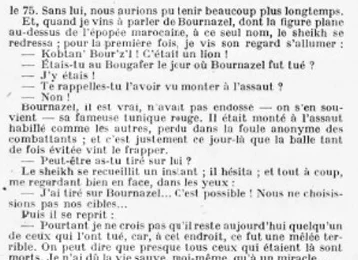
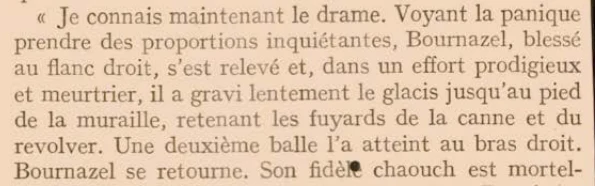
The sources agree on the date, the general place (the assault on piton 6, east of the Bou Gafer) and two successive wounds. Gérardin gives the time (7.20), the firing position (“a staggered low wall”) and the second wound (wrist).
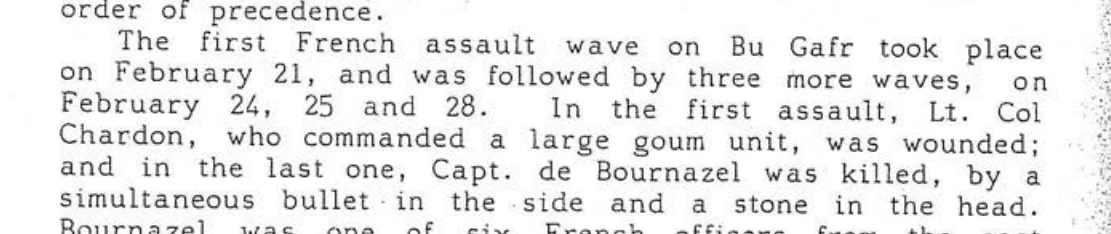
They diverge on the rest. Dress: Bordeaux (1935) reports the order to cover the red tunic with a “grey djellaba” and himself calls the replies then attributed to Bournazel “stupid and arranged remarks”; Saulay (1983) speaks of a “khaki gandoura”. The second wound: in the wrist (Gérardin), in the right arm (Dr Vial, quoted by Bordeaux), or a stone to the head together with a bullet in the side (Hart, 1984). Death: evacuated, he died that day (Gérardin, Wikipedia), or he died on the mountain after Vial's care (Bordeaux).
The detail of the wounded man dragged by the feet over the rocks, shared by Bordeaux and Saulay, suggests the latter partly depends on the former. As for the shooter, no written source consulted gives a name. Three voices from the defenders' side exist, all indirect: around 1946 a sheikh tells Soubrier he “may” have shot at him; a family tradition published in 2023 attributes the shot to an unnamed fighter of the Aït ʿAïsa ou Brahim, with a silver bullet; Hart, who questioned Assou's son, only writes that Bournazel was killed “by a simultaneous bullet in the side and a stone in the head”. The Aït ʿAïsa ou Brahim were indeed part of the core of the defenders, according to Spillmann as well as Qaid ʿAli: the tradition is plausible, not demonstrated. A name also circulates online without any verifiable text consulted; it is not repeated here.
These accounts are written from the attacker's point of view. For the Aït Atta, 28 February was the day the fourth assault was repelled; the command then gave up taking the massif by force and chose to starve it out, cutting off access to the water points of Akka n'Oulili and Akka n'Khouya Brahim and bombarding day and night, according to Huré's plan quoted by M. Boukbout (trans. of Spillmann, n. 34). Bournazel's death is an episode in the defence of the Bou Gafer, not its centre; Hart notes that Assou knew his reputation without ever having met him.