From the sixteenth century to the present
History of the Aït Atta
Four centuries of the history of a confederation, from its first written mentions to 1956, and what the sources really allow us to date.
Confederation and sections →Timeline →Dadda Atta →
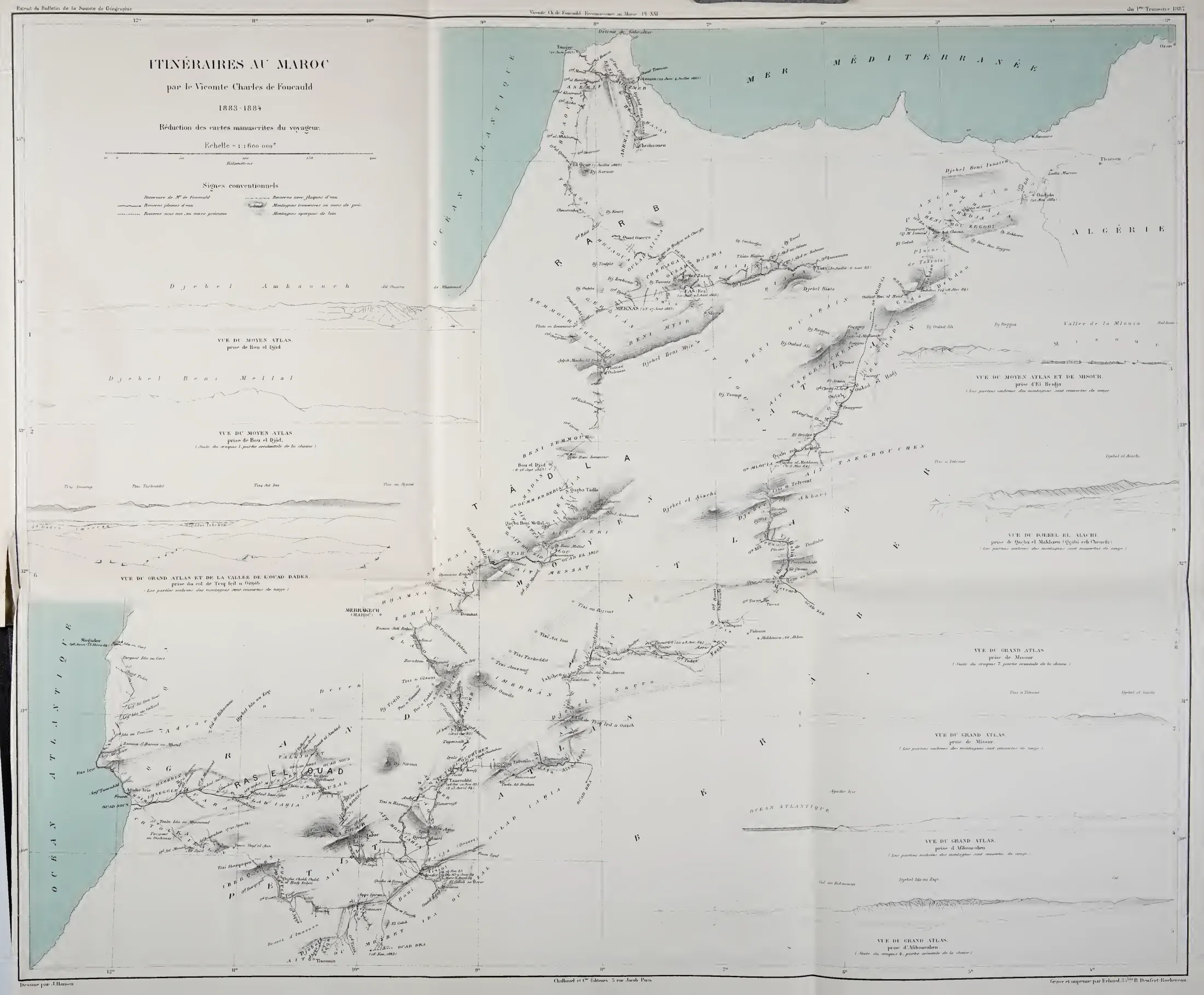
Routes in Morocco by Charles de Foucauld, 1883-1884 (general map) — Internet Archive (exemplaire du Getty Research Institute), via Wikimedia Commons ; autre exemplaire : BnF (Gallica), Domaine public
What can be dated
The ancient history of the Aït Atta rests on two kinds of evidence that must be kept apart: the traditions they hand down themselves (Dadda Atta, his forty grandsons, the pacts) and the written mentions, almost all external: Moroccan chronicles, European travellers, then French officers. A tradition that places an origin in a distant past does not supply its date.
The oldest known written mention is that of Luis del Mármol Carvajal, in 1571, who speaks of a “province of Ytata” (Hart, 1989). For the seventeenth and eighteenth centuries, the dated landmarks come mainly from the Makhzen's expeditions to the South; conflicts between Aït Atta groups are often known only through memory collected in the twentieth century, without a sure date.
Assisted translation, not validated
Sources — 2 sources cited · 2 independent documentary line(s)
Origins and organisation (sixteenth century)
All the tribes claim descent from Dadda Atta, without being able to trace their links to him; his relations with the saint Moulay ʿAbdallah bin l-Hsain, who died around 1568-1571, allow him to be placed cautiously in the sixteenth century (see the Dadda Atta dossier). Hart and Spillmann place the organisation of the confederation in this period. Spillmann explains it by the will to throw off an “Arab yoke”; his translator M. Boukbout refutes this ethnic reading, which he links to colonial policy, and recalls that the Aït Atta's alliances with or against the Makhzen followed political and economic interests.
The confederation then describes itself in five “fifths”, then in tribes, lineages and families; a stranger can be integrated into a lineage by sacrificing an animal (Spillmann). The structure of the khmas and the place of each group are detailed on the “Confederation and sections” page.
Assisted translation, not validated
Sources — 3 sources cited · 3 independent documentary line(s)
- Spillmann et al., 2007 — trad. p. 35-38, n. 21 et 27 (orig. p. 40-45)Excerpts consulted · Colonial military
Expansion (sixteenth to nineteenth century)
From the Saghro and the Ougnat, the heart of the country, the Aït Atta spread in every direction. Hart places their first movement towards the Central Atlas in the mid-sixteenth century, as long-distance nomads, and has their advance south of the Saghro begin in earnest only after 1800 (1984, pp. 6-7). Spillmann describes, after Captain de La Chapelle, three axes of progress northwards (the Dadès and the Ahansal in the west, the Gheris in the centre, the Ziz in the east) and success mainly in the west, thanks to the friendship of the Ahansal marabouts.
Opposite them, the Aït Yafelman confederation formed in 1644 or 1645 to counter them, with the Makhzen's support according to Spillmann. Aït Atta groups settled in the Middle Atlas (Aït Atta n'Oumalou, Ouaouizeght), at Ousikis and Msemrir; a colony reached the outskirts of Meknes. In the south, the Draa, the Dadès, the Todgha, the Ferkla and the Tafilalet are lands taken or protected under more recent agreements, which the Aït Atta exploit alongside the oasis cultivators.
Assisted translation, not validated
Sources — 3 sources cited · 3 independent documentary line(s)
- Spillmann et al., 2007 — trad. p. 32, n. 12 de l'auteur (orig. p. 36-37)Excerpts consulted · Colonial military
Facing the Alaouite Makhzen (1678-1894)
In the eighteenth century, at the height of Aït Atta expansion, the Alaouite sultans intervened in the South. Spillmann counts, between 1678 and 1816, expeditions by four sultans to the Tafilalet and the Draa: Moulay Ismail in 1678 and again around 1724-1725, Moulay Abdallah in 1730, Sidi Mohammed ben Abdallah, Moulay Slimane from 1801 to 1816. His translator corrects and supplements these dates (1769, 1777 towards the Saghro, 1783) from the work of A. Bouzidi and M. Boukbout.
In the mid-nineteenth century, the central power followed southern affairs less closely, and Moulay Hassan did not manage, according to Spillmann, to restore the situation. The translator recalls that there were also agreements by which Aït Atta undertook to serve the Makhzen: relations cannot be reduced to hostility on principle.
Assisted translation, not validated
Sources — 2 sources cited · 2 independent documentary line(s)
- Spillmann et al., 2007 — trad. p. 35-36, n. 20 et 21 (orig. p. 41-42)Excerpts consulted · Colonial military
Rivalries, alliances and institutions (nineteenth century)
Unable to prevail over the Aït Yafelman, their equals in strength, the Aït Atta came to terms with a status quo on the Todgha-Ferkla-Gheris front; the Tafilalet remained a field of clashes between the Aït Merghad, Aït Khebbach and Aït Isfoul (Spillmann). In spring 1883, an Aït Atta harka of 8,000 foot and 600 horse is said to have been defeated there near Tilouine, with 1,600 dead, figures from a single source.
Internally, the khmas fought one another: the Aït Ounir, Aït Isfoul and Aït Yazza against the Aït Ouahlim, long dominant; Hart reports a war of “seven years” of all the Aït Atta against the Ilemchan. Tafergant pacts bound groups: the Aït Ounir and Aït Isfoul, the Aït Khebbach and Bni Mhammed. The common institutions remained: the appeal court at Igherm Amazdar and the red banner of the confederation, kept at Igherm Amazdar, carried by the Aït Yazza and brought out only when the whole harka was assembled (Spillmann, after La Chapelle).
Assisted translation, not validated
Sources — 2 sources cited · 2 independent documentary line(s)
- Spillmann et al., 2007 — trad. p. 36-37, n. 24 et 25 (orig. p. 42-43)Excerpts consulted · Colonial military
Conquest and the end of unity (1900-1932)
The occupation of the Algerian oases (1902), then of Boudenib (1907), pushed the Aït Atta westwards: according to Spillmann, they turned their efforts to the Dadès and the Draa, where they then quarrelled over the conquered lands. By the end of the nineteenth century, the confederation no longer had a common supreme chief or a general assembly; it re-formed case by case, at the call of a notable or against the French.
Between 1929 and 1932, French posts were established in the Dadès, the Todgha, the Draa and at Tazarine; some groups remained neutral, others went over to the Makhzen or the Glaoui, others refused. In 1932 the Aït Khebbach “preferred exile to submission”, Spillmann writes, and the groups still fighting fell back on the Saghro, where the war of 1933 was played out.
Assisted translation, not validated
Sources — 1 sources cited · 1 independent documentary line(s)
- Spillmann et al., 2007 — trad. p. 30, 37-38 (orig. p. 34, 42-44)Excerpts consulted · Colonial military
The Bougafer and after
The war of the Saghro, from February to March 1933, and that of the Baddou, the following summer, have their own pages. After 1933, the customary court of Igherm Amazdar sat in a building put up in 1938; Assou Oubasslam became caid of the Aït Atta of the Saghro. Independence in 1956 ended the customary jurisdictions; the commemorations of the Bougafer and the work of Moroccan historians then made the battle a national site of memory.
Assisted translation, not validated
Sources — 1 sources cited · 1 independent documentary line(s)