Explore Bougafer
The international press and the Saghro (1932-1933)
What newspapers and reviews published outside France and Morocco reported about the Saghro, read on the page images. Each item is dated, located and assessed; reprints of the same dispatch count as a single testimony.
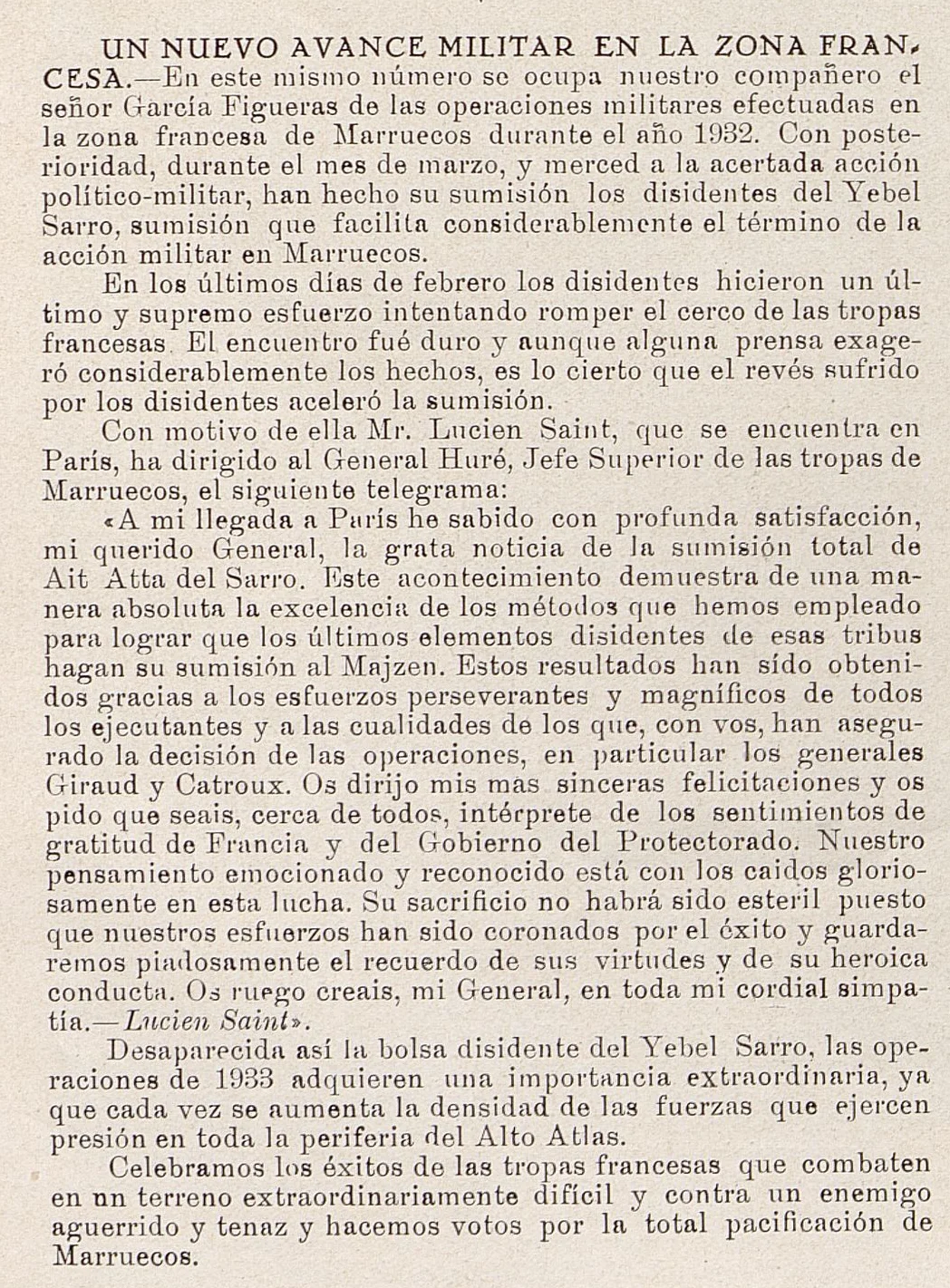
“Un nuevo avance militar en la Zona Francesa”, África, March 1933 — CSIC, Biblioteca Tomás Navarro Tomás (Simurg), CC BY-NC-SA 4.0 (copie numérique CSIC)
Method: full-text search in digitised holdings open to queries (CSIC Simurg, KB Delpher), reading of the whole page, check of the quotation on the image, identification of the agency and of what the item relays. Working translations by SAGHRO.
- De Locomotief · Semarang (Indes néerlandaises)Indonesia · Dutch
n° 280 · p. 5
De Franschen in Marokko. Militaire Penetratie.
DispatchAneta-Havas — Rabat, 29 novembre 1932
Er is een nieuwe verbinding tot stand gekomen tusschen het Marrakech-gebied en de linie Djebel-Sagho; alle Ksours in het tusschenliggende gebied hebben zich aan de Franschen onderworpen.
Translation“A new link has been established between the Marrakech region and the Djebel-Sagho line; all the ksour in the area in between have submitted to the French.”
- What the item says
- Havas dispatch from Rabat, relayed as far as Java: the junction between the Marrakech region and the “Djebel-Sagho line” is complete; the dispatch announces that the ksour in between “have submitted”.
- Critical assessment
- French official communiqué passed on by two agencies: it shows that the encirclement of the Saghro at the end of November 1932 was announced in the international press, but brings no independent information.
View the page at the institution ↗LibraryKoninklijke Bibliotheek (KB), Delpher — exemplaire des bibliothèques universitaires de LeydeQuotation checked on the image on 2026-11-08Anonymous 1932-1933 agency dispatch, in the public domain; facsimile on Delpher (KB). Quotation and working translation by SAGHRO.
- África. Revista de Tropas Coloniales · CeutaSpain · Spanish
época II, n° 99 (mars 1933) · p. 60 · Ecos
Un nuevo avance militar en la Zona Francesa
En los últimos días de febrero los disidentes hicieron un último y supremo esfuerzo intentando romper el cerco de las tropas francesas. El encuentro fué duro y aunque alguna prensa exageró considerablemente los hechos, es lo cierto que el revés sufrido por los disidentes aceleró la sumisión.
Translation“In the last days of February the dissidents made a last and supreme effort to break the encirclement of the French troops. The encounter was hard and, although some press considerably exaggerated the facts, it is certain that the setback suffered by the dissidents hastened the submission.”
- What the item says
- Unsigned note announcing that in March “han hecho su sumisión los disidentes del Yebel Sarro”; the encounter at the end of February was “hard” and “some press” exaggerated the facts. The review reproduces Lucien Saint's telegram to Huré, which hails “la sumisión total de Ait Atta del Sarro”, thanks generals Giraud and Catroux and pays tribute to the French dead.
- What it relays
- Resident General Lucien Saint's telegram to General Huré, translated into Spanish.
- Critical assessment
- Viewpoint of Spanish military Africanism, favourable to the French army (“Celebramos los éxitos de las tropas francesas”). The information comes from French official communication: it is not an independent testimony on the fighting. The remark about a press that “exaggerated” shows that divergent accounts of 28 February were circulating; the note does not say which. The issue, dated March, reports the agreement at the end of that month.
Document“Un nuevo avance militar en la Zona Francesa”, África, March 1933Mars 1933 (numéro daté ; rapporte la soumission de la fin du mois)CSIC, Biblioteca Tomás Navarro Tomás (Simurg) View the page at the institution ↗LibraryCSIC, Biblioteca Tomás Navarro Tomás (Simurg)Quotation checked on the image on 2026-11-08Unsigned 1933 text; digital copy CC BY-NC-SA 4.0 (CSIC). Crop reproduced under the same licence, no commercial use.
- África. Revista de Tropas Coloniales · CeutaSpain · Spanish
época II, n° 100 (avril 1933) · p. 73 · Crónica mensual de la Zona francesa · J. Carrasco Téllez (Casablanca, avril 1933)
Crónica mensual de la Zona francesa
La pacificación del Yebel Sarro marca una nueva e importante etapa en la pacificación general de Marruecos.
Translation“The pacification of Djebel Sarro marks a new and important stage in the general pacification of Morocco.”
- What the item says
- Chronicle written in Casablanca: after “Yebel Sarro” there remains “the stain of the Central Atlas”, inhabited by people who “also enjoy the renown of the Ait Atta” of never having let an enemy set foot on their soil. The author draws the consequences for Spain: the question of Río de Oro and Mauritania will soon arise.
- Critical assessment
- Signed opinion piece, without any detail of the fighting: the end of the Saghro resistance matters to it only for its strategic consequences for Spain. It attests to the reputation for invincibility attached to the Aït Atta in the colonial press of 1933.
View the page at the institution ↗LibraryCSIC, Biblioteca Tomás Navarro Tomás (Simurg)Quotation checked on the image on 2026-11-08Signed article (author's date of death unknown): short quotation only.
- De Tijd · 's-HertogenboschNetherlands · Dutch
n° 27114, édition du soir · p. 9
Zware verliezen in Marokko
DispatchReuter — Paris, 22 août 1933
3 newspapers reproduce this same dispatch: a single line of evidence.
Het blad schat het aantal dooden bij de militaire operaties in Djebel Badur op 2 à 3.000 dooden aan beide zijden. […] Ook in het gebied van Djebel Sagho schat het blad de verliezen sedert het begin der operaties op ongeveer drieduizend dooden.
Translation“The paper puts the number of dead in the military operations on Djebel Badur [Baddou] at 2,000 to 3,000 on both sides. […] In the Djebel Sagho area too, the paper estimates the losses since the beginning of the operations at about three thousand dead.”
- What the item says
- Dispatch from Paris: according to L'Humanité, French operations in Morocco come with very heavy losses: 2,000 to 3,000 dead on both sides on Djebel “Badur” (Baddou); as of 7 August, 120 dead reported in the Foreign Legion and 1,000 among auxiliary troops; about 3,000 dead in the “Djebel Sagho” area since the operations began.
- What it relays
- An article in L'Humanité (daily of the French Communist Party), not consulted.
- Critical assessment
- A single testimony, reprinted by three newspapers: a dispatch relaying a campaigning source, without stating where the figures come from. The “Djebel Sagho” figure does not distinguish between sides. The headlines show three framings of the same text: “Heavy losses” (Het Volk), “Bloody pacification… a communist report” (Het Vaderland), “Severe losses” (De Tijd). To be filed with the contradictory estimates, not adopted as a toll.
View the page at the institution ↗LibraryKoninklijke Bibliotheek (KB), DelpherQuotation checked on the image on 2026-11-08Anonymous 1932-1933 agency dispatch, in the public domain; facsimile on Delpher (KB). Quotation and working translation by SAGHRO.
- Het Vaderland · La HayeNetherlands · Dutch
édition du soir · p. 5
Bloedige pacificatie van Marokko — Een communistisch bericht
DispatchReuter — Paris, 22 août 1933
3 newspapers reproduce this same dispatch: a single line of evidence.
Het blad schat het aantal dooden bij de militaire operaties in Djebel Badur op 2 à 3000 dooden aan beide zijden. […] Ook in het gebied van Djebel Sagho schat het blad de verliezen sedert het begin der operaties op ongeveer drieduizend dooden.
Translation“The paper puts the number of dead in the military operations on Djebel Badur [Baddou] at 2,000 to 3,000 on both sides. […] In the Djebel Sagho area too, the paper estimates the losses since the beginning of the operations at about three thousand dead.”
- What the item says
- Dispatch from Paris: according to L'Humanité, French operations in Morocco come with very heavy losses: 2,000 to 3,000 dead on both sides on Djebel “Badur” (Baddou); as of 7 August, 120 dead reported in the Foreign Legion and 1,000 among auxiliary troops; about 3,000 dead in the “Djebel Sagho” area since the operations began.
- What it relays
- An article in L'Humanité (daily of the French Communist Party), not consulted.
- Critical assessment
- A single testimony, reprinted by three newspapers: a dispatch relaying a campaigning source, without stating where the figures come from. The “Djebel Sagho” figure does not distinguish between sides. The headlines show three framings of the same text: “Heavy losses” (Het Volk), “Bloody pacification… a communist report” (Het Vaderland), “Severe losses” (De Tijd). To be filed with the contradictory estimates, not adopted as a toll.
View the page at the institution ↗LibraryKoninklijke Bibliotheek (KB), DelpherQuotation checked on the image on 2026-11-08Anonymous 1932-1933 agency dispatch, in the public domain; facsimile on Delpher (KB). Quotation and working translation by SAGHRO.
- Het Volk · AmsterdamNetherlands · Dutch
n° 12269, édition du soir · p. 2
Groote verliezen in Marokko — Cijfers van de „Humanité”
DispatchReuter — Paris, 22 août 1933
3 newspapers reproduce this same dispatch: a single line of evidence.
Het blad schat het aantal dooden bij de militaire operaties in Djebel Badur op 2 à 3000 aan beide zijden. […] Ook in het gebied van Djebel Sagho schat het blad de verliezen sedert het begin der operaties op ongeveer drieduizend dooden.
Translation“The paper puts the number of dead in the military operations on Djebel Badur [Baddou] at 2,000 to 3,000 on both sides. […] In the Djebel Sagho area too, the paper estimates the losses since the beginning of the operations at about three thousand dead.”
- What the item says
- Dispatch from Paris: according to L'Humanité, French operations in Morocco come with very heavy losses: 2,000 to 3,000 dead on both sides on Djebel “Badur” (Baddou); as of 7 August, 120 dead reported in the Foreign Legion and 1,000 among auxiliary troops; about 3,000 dead in the “Djebel Sagho” area since the operations began.
- What it relays
- An article in L'Humanité (daily of the French Communist Party), not consulted.
- Critical assessment
- A single testimony, reprinted by three newspapers: a dispatch relaying a campaigning source, without stating where the figures come from. The “Djebel Sagho” figure does not distinguish between sides. The headlines show three framings of the same text: “Heavy losses” (Het Volk), “Bloody pacification… a communist report” (Het Vaderland), “Severe losses” (De Tijd). To be filed with the contradictory estimates, not adopted as a toll.
View the page at the institution ↗LibraryKoninklijke Bibliotheek (KB), DelpherQuotation checked on the image on 2026-11-08Anonymous 1932-1933 agency dispatch, in the public domain; facsimile on Delpher (KB). Quotation and working translation by SAGHRO.
Limits of the search (8 November 2026)
- Hemeroteca Digital of the National Library of Spain: automated access blocked by its security systems; not circumvented. Issues of El Heraldo de Madrid, Luz, La Época or El Siglo Futuro from 1933 are indexed there and remain to be read.
- Biblioteca Virtual de Prensa Histórica: full-text search engine returning a server error at the time of the search.
- La Vanguardia and the Arxiu de Revistes Catalanes Antigues: captcha; not circumvented.
- Gallica (French press, including L'Humanité) and Chronicling America (Library of Congress): automated requests refused; to be consulted manually.
- No Spanish, Dutch or other article is presented here without having been read on the image of its page.